
Will government shutdown stall Hanford clean up? What we know
AI-generated summary reviewed by our newsroom.
- DOE holds roughly 30 days of carryover funding to maintain Hanford work.
- Contractors and DOE will triage tasks to protect safety if funds lapse.
- Vitrification startup and EPA oversight face risk amid shortfalls in 2025.
The Department of Energy appears to have enough money for four weeks of operations during the federal government shutdown, according to state officials at the Oregon Hanford Cleanup Board’s virtual meeting Tuesday.
With little information about the shutdown specific to Hanford released to the public by the Department of Energy, officials at the meeting discussed what they had heard or surmised about the nuclear site.
After the cleanup board meeting, DOE said in a statement that its “Hanford site is not currently experiencing a lapse in funding and continues to operate in a normal capacity, with staff reporting to work and carrying out the Hanford mission safely.”
Environmental cleanup work at the Hanford nuclear site in Eastern Washington appears to be continuing as usual for the most part, said Max Woods, assistant director of nuclear safety and energy security at the Oregon Department of Energy, at the Tuesday meeting.
But even if the money that Hanford has left from the fiscal year that ended last Tuesday is exhausted after four weeks, it would be difficult to imagine that critical work at the site would not continue, he said.
However, some work might be paused or even stopped, he speculated.
Suzanne Dahl, the Hanford tank waste treatment section manager for the Washington state Department of Ecology, said she had heard similar information — that money left from fiscal 2025, which ended Sept. 30, is being used for Hanford operations.
Typically when such carry-over funding is exhausted, the DOE contractors at Hanford and DOE identify what the minimum activities are that are needed to keep the site safe and which workers are needed for that, she said.
About 13,000 people work at Hanford, most of them employed by contractors who are paid with federal money.
The shutdown comes as DOE faces a federal court deadline of Oct. 15 to turn the first of the radioactive and hazardous chemical waste now stored in underground tanks into a stable, but still radioactive, form for disposal.
Work to build the Waste Treatment Plant, or vitrification plant, to treat much of the waste started in 2002.
DOE still is actively working toward meeting the Oct. 15 deadline, Dahl said.
The state announced on Oct. 1 that it had issued the last permit and license DOE needed to begin radioactive waste treatment at the vitrification plant.
The plant’s 300-ton melters that will be used initially to treat waste have already been heated up to practice making glass with a nonradioactive waste simulant and must now be kept on around the clock until they are taken out of service.
The U.S. Environmental Protection Agency, a Hanford regulator along with the state Department of Ecology, apparently has less than 30 days of carry-over funding, but it is not known how much less, said Stephanie Schleif program manager for Ecology’s Nuclear Waste Program.
The EPA staff that regulates Hanford work has not been impacted yet, but could be with very little notice, she said.
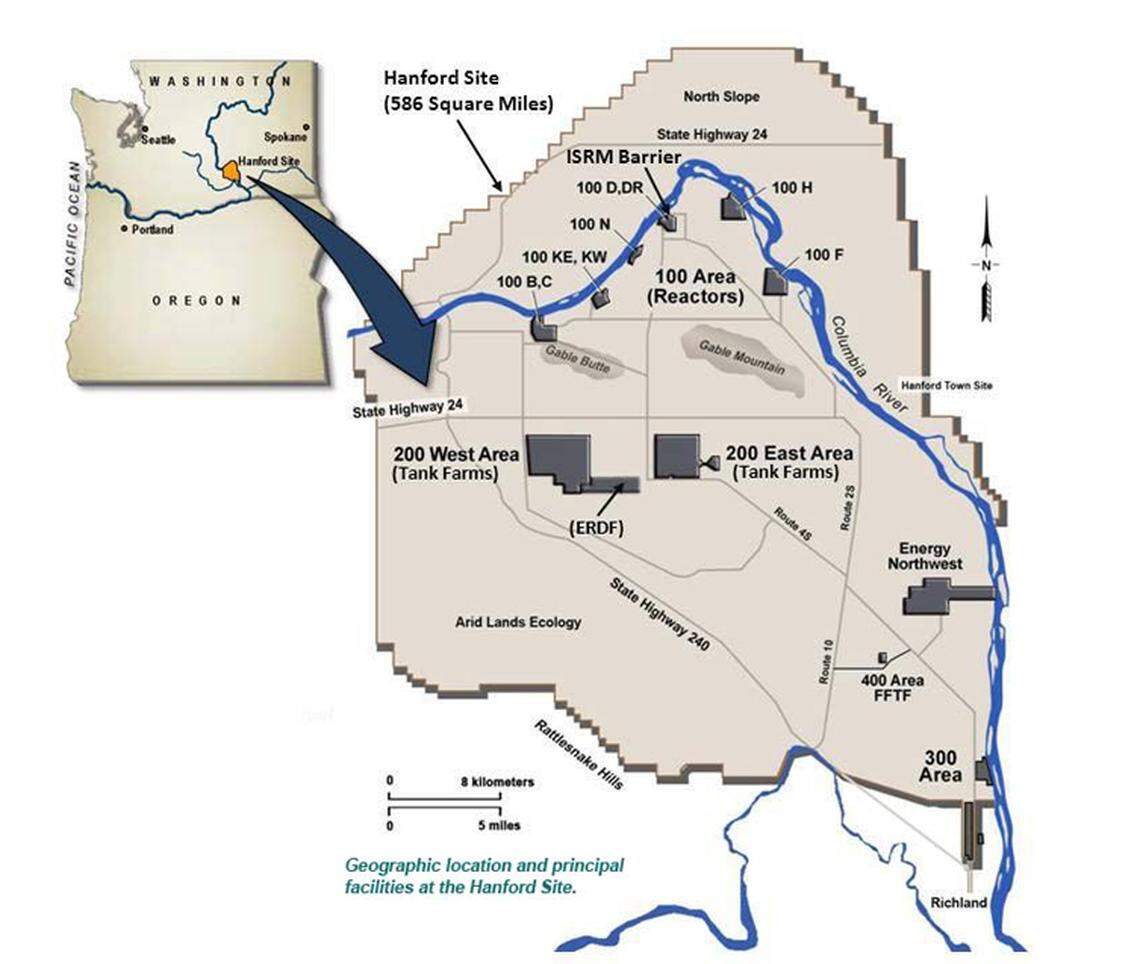
The Hanford nuclear site, adjacent to Richland, was used from World War II through the Cold War to produce nearly two-thirds of the plutonium for the nation’s nuclear weapons program.
Now about $3 billion is spent annually on environmental cleanup of the 580-square-mile site, including managing 56 million gallons of radioactive and hazardous chemical waste stored in underground tanks until it can be treated for disposal. The vitrification plant is planned to glassify much of the waste, and some of the less-radioactive waste in the tanks also is expected to be turned into a concrete-like grout.
This story was originally published October 8, 2025 at 9:23 AM with the headline "Will government shutdown stall Hanford clean up? What we know."