
WA must act to ensure Cascadia’s dominance in AI, business leaders warn
AI-generated summary reviewed by our newsroom.
- Cascadia leaders urge rapid AI investment to secure regional economic leadership.
- BCG report flags housing, energy, taxes and talent as barriers to competitiveness.
- Calls mount for zoning, tax reform and training programs to retain local talent.
Washington, along with its Cascadia regional counterparts, should “seize the AI opportunity.”
That was one of the main takeaway from the first day of the 2025 annual Cascadia Innovation Corridor Conference, held in Seattle Oct. 28 and 29. Attendees included leading lawmakers and business kingpins, and the event coincided with the release of a report analyzing the region’s weaknesses, strengths and opportunities in becoming a global artificial-intelligence hub.
The Evergreen State has earned a reputation for being on the Big Tech forefront, with titans like Microsoft and Amazon calling it home.
But speakers warned that that position could be jeopardized if the Cascadia mega-region — stretching from Portland through Seattle and up to British Columbia — doesn’t actively tackle ongoing problems threatening its tech-frontrunner standing.
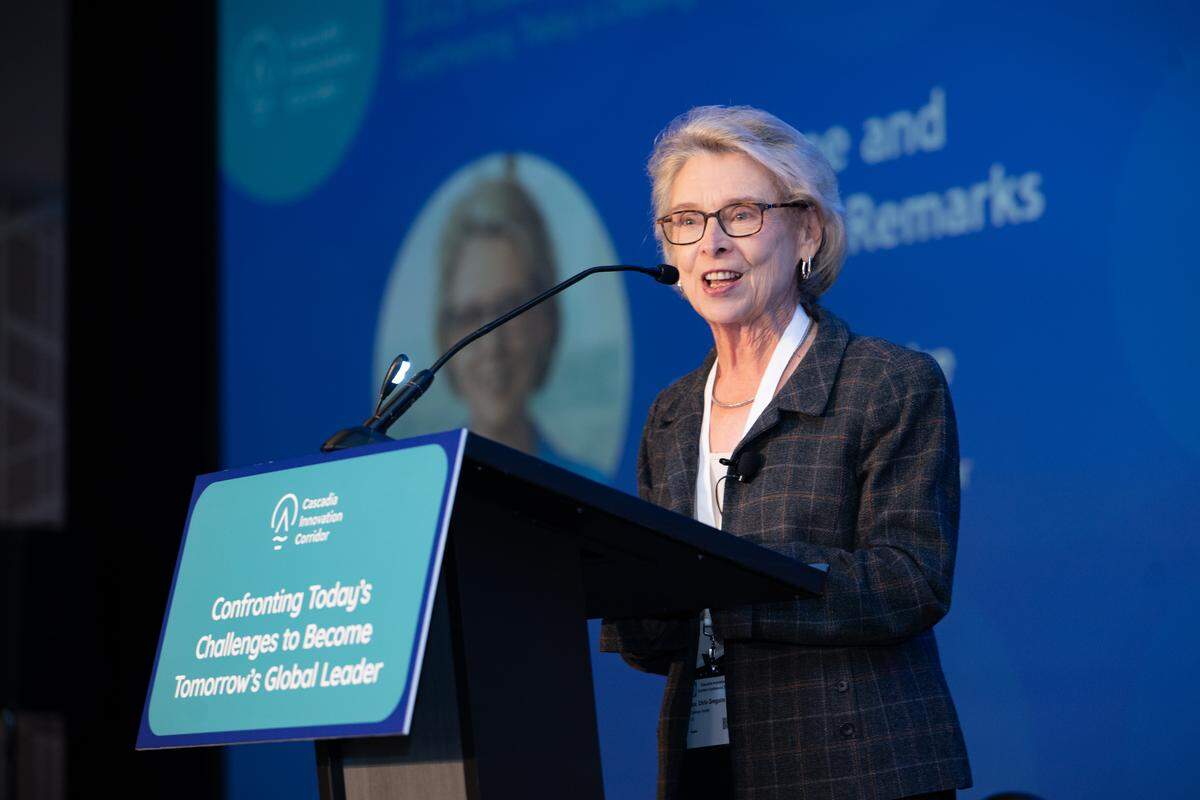
Former Washington Gov. Chris Gregoire warned those gathered Oct. 28 at the Sheraton Grand Seattle.
“The next 10 years will determine whether Cascadia continues to lead, or risks being left behind,” she said.
Up for discussion Oct. 28: The just-released report from Boston Consulting Group, “Cascadia’s AI moment?: Confronting Today’s Challenges to Become Tomorrow’s Global Leader.” The analysis identified four threats to the mega-region’s advantages: the housing crisis, an increasingly difficult business environment, energy infrastructure limitations and a fragile talent pipeline.
The report found that the region must, in part, return its focus to providing sustainable and predictable tax policies and streamlined regulatory processes. It also suggested zoning reform and the removal of hurdles to help improve housing affordability.
Its publication comes months after the Washington state Legislature wrapped up a session that Democrats lauded as the “year of housing,” citing new laws to boost supply. Yet the majority party has also taken heat from the business community — including from Microsoft President Brad Smith — for adopting record tax hikes.
Gregoire said the Cascadia corridor has everything needed to continue to carry the torch in innovation.
“We have punched well above our weight for the last decade,” she said, “but we cannot take it for granted.”
Gov. Bob Ferguson was scheduled to speak Oct. 29. His office announced that as part of the conference, leaders from Washington, Oregon and British Columbia had recommitted to their cross-border partnership by signing a memorandum of reaffirmation. The gist: to advance affordability, sustainability, innovation and connectivity, such as a Cascadia-connecting high-speed rail.
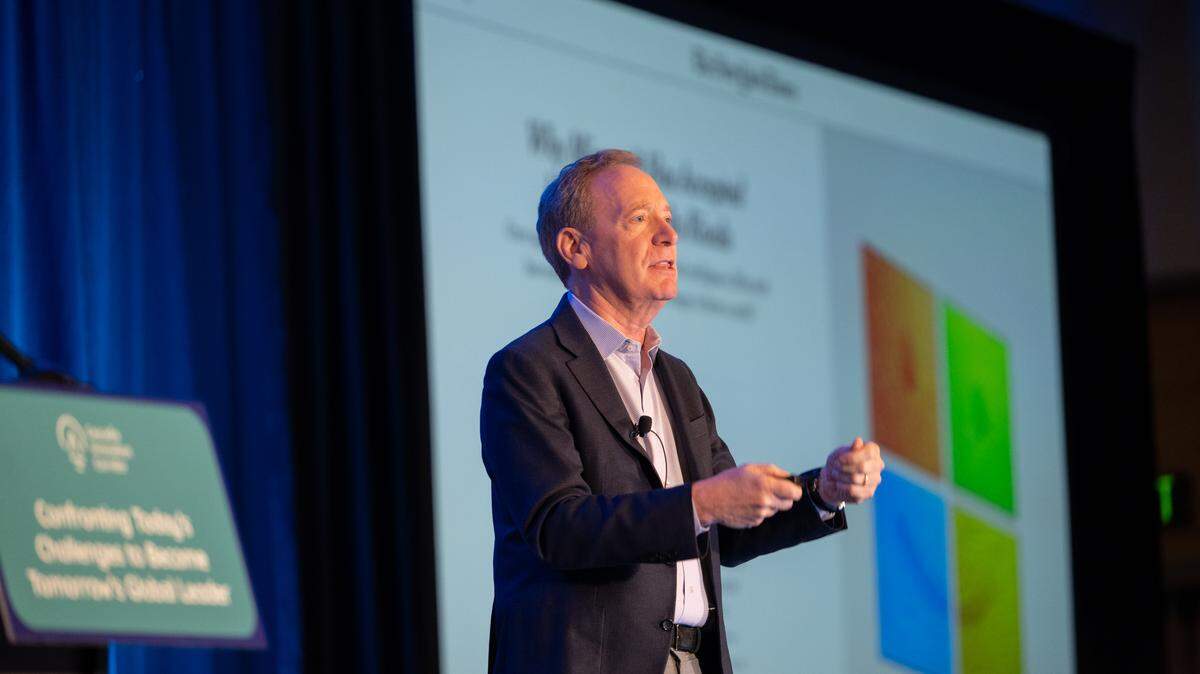
Microsoft’s Smith took the stage after Gregoire and marked a major upcoming milestone. In just a couple months, the 21st century’s first quarter comes to a close, and the second quarter begins.
AI, he said, will soon mirror electricity as the “next great general purpose technology” that will wholly transform the economy. In his view, AI will reshape the globe from now until 2050. Perhaps it will help discover better ways of conducting cancer research or methods to attain larger agricultural yields in environmentally sound ways.
But Smith conveyed a sense of urgency.
“We are embarking on a great race,” he said, “not just as an industry and companies, but as regions competing with each other.”
Washington has work to do, Smith warned, when it comes to ease of doing business, having recently slid in the ranks. He said the progressive and business communities are more divided than ever.
Cascadia’s economic competitiveness was robust in the mid-2010s, according to the report, with 25 new tech jobs getting added every day in downtown Seattle. But 10 years later, wages aren’t keeping up with housing prices. Washington and Oregon are among the costliest states to do business.
Greater Seattle — which includes King, Pierce and Snohomish counties — stands out in the aerospace, cloud computing and e-commerce sectors, the report says. To retain its standing, it will have to cut back on regulatory and business-cost barriers and invest in housing, transportation and child care.
The report also warns that without business reforms, the area will lose investment to more predictable and affordable regions. Tax policy should motivate businesses to move to, start in, and grow in the region, it says.
Outside of business, the report suggests expanding apprenticeships, mentorship networks and co-op programs to strengthen and retain local talent. And the region should devise a “coordinated energy roadmap” to secure affordable and dependable renewable power.
“If we’re going to reinvest in this social compact, we need to keep reinvesting in each other: people from different political parties, from different countries and states, from different parts of an extraordinary ecosystem of people,” Smith said.
“That is how we will succeed.”
This story was originally published October 30, 2025 at 5:00 AM.
.jpg)