
Remember Tim Eyman? He's bearing bad news - for his own side
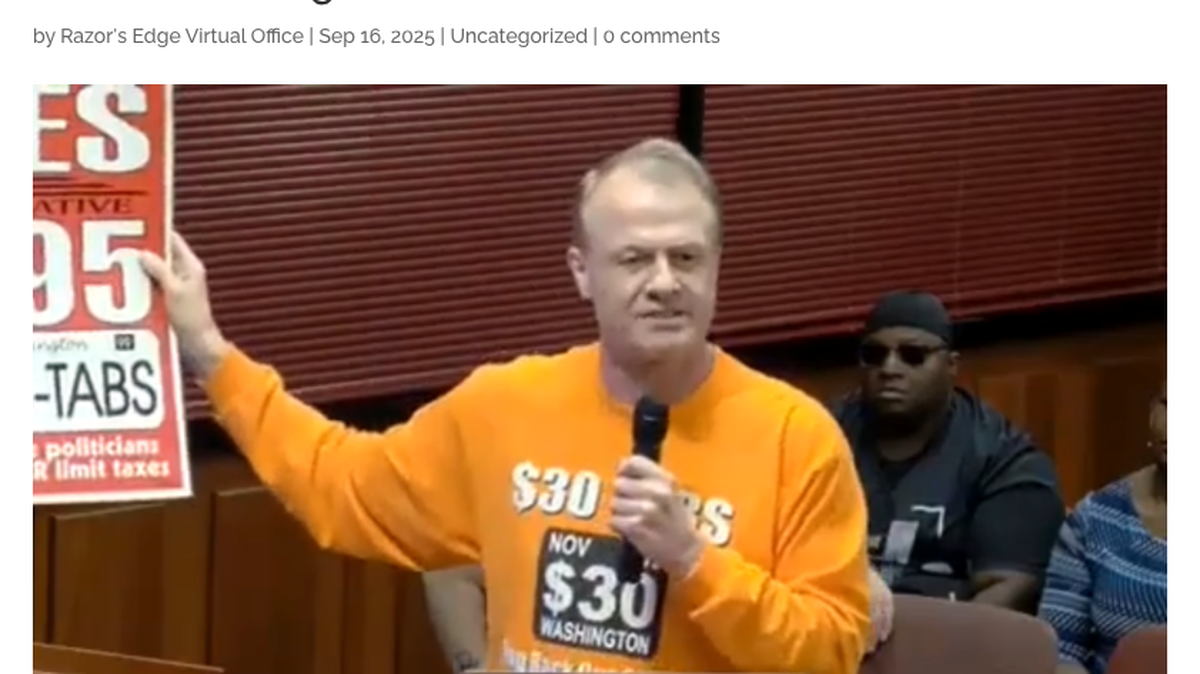
Tim Eyman is still around. He’s still a thorn in the side.
Only this week he’s been a prickly annoyance for his own side - the one that’s convinced a new millionaires tax” is a horrible idea, hated by the public.
“A lot of people on our side will not like hearing this,” Eyman acknowledged to his 60,000-strong email list.
For those new to town, Eyman is a political gadfly who used to dominate the business of running conservative ballot measures in this state, mostly to cut, freeze or limit taxes.
He’s largely out of that game now, by court order. In 2021 he was found to have broken campaign finance rules to line his own pockets with donor funds. So he’s barred from managing political money anymore.
But he’s still doing “nonstop activism,” as he described to me Tuesday.
“I’m on my way to Wapato today to speak to some folks who are opposing the state income tax fiasco,” he said.
But this week it was Eyman providing a dose of cold, blue-state reality. He shipped around the results of a poll, commissioned by business interests, showing that the notion of repealing the new “millionaires tax” at the ballot box is shaky.
“The word I used is ‘doomed,’ Eyman said. “If we try to repeal this income tax this November, that effort is doomed.”
The poll was done in April, after the “millionaires tax” passed the state Legislature in March.
Using a similar ballot title from a repeal initiative that has already been filed, the poll found that 59% would vote to uphold the tax. While only 33% said they’d vote to get rid of it.
This roughly matches a statewide poll I reported on in January. That survey found that taxing super-high incomes with a 9.9% state income tax is popular across every demographic - young and old, rural and urban. Even a slight majority of Republicans said they liked it.
It also matches internal Democratic polling I’ve seen on the topic.
Of course that was before the tax was passed. Before House Republicans ran a 25-hour filibuster against it. Before business and tech leaders denounced it. And before opponents sued, contending it’s unconstitutional.
None of that sound and fury appears to have signified much. Not yet.
Eyman said the figure of 33% saying yes to repeal would realistically need to be above 60% at this stage of the political year for an initiative to have much chance.
Eyman wouldn’t share the poll cross tabs, or who the pollster was, so I can’t vet the methodology. He said he got it from a business lobbyist, and that it was commissioned by “people invested in the idea of overturning the tax.”
He said he publicized it because “I don’t want the income tax to pass.” But if it’s put up to a public vote this year, he said, the income tax will survive.
“I don’t pretend to know a lot about everything,” he said in his letter to his followers. “But I do know a lot about ballot measures.”
What should we make of this information?
Eyman mostly blames new ballot rules for the anti-tax side being so far underwater. Democrats in 2022 passed a rule that basically calls for a disclosure label on tax measures. Right on the ballot it states what effect the measure would have on the budget.
So for example, the 2024 vote to repeal a capital gains tax had an added sentence that said: “This measure would decrease funding for K-12 education, higher education, school construction, early learning and childcare.” That was factual; the tax revenue had been earmarked for those things. The repeal went down in flames.
Eyman calls it a “sabotage sentence” that carries a built-in pro-government bias. Or as Eyman’s former initiative partner Edward Agazarm, aka Eddie Spaghetti, satirized on X: “WARNING if you vote yes the childrens will starve and elderly will die.”
Maybe. Or maybe voters simply favor schools over tax cuts for the rich?
Eyman argues it’s no coincidence that he was able to pass anti-tax measures for more than two decades, but now every measure with this new disclosure label has failed - and failed overwhelmingly.
The state’s politics haven’t changed that much, he says.
I do wonder what it says about us politically. It seems to mean we want both lower taxes and more government spending. So if presented with just one or the other, we vote “yes.”
But if presented with both on the same ballot item, so far the people have been overwhelmingly favoring the higher spending side.
This is perhaps why government spending is always soaring, at the local, state and national levels, no matter who is in charge. For all the carping about it, voters like it.
Eyman disputes that, of course. To him, Democrats have put a “thumb on the scales.”
But he ended envisioning a light over the horizon: “I think 2027 will be a much better year for repealing the income tax.
With that, he was headed quixotically off toward that horizon, to make the case, out in Wapato.
Copyright 2026 Tribune Content Agency. All Rights Reserved.
This story was originally published May 6, 2026 at 6:54 AM.