The Wolf Moon will howl at five planets above WA this week. Here’s how to view them all
Three of the largest celestial objects in our night sky will be on full view later this week, and thanks to some perfect timing and alignment in the night sky, up to five planets will be visible to Washington stargazers.
It may not technically be the largest object, but from our point of view, a full moon known as a “Wolf Moon” will rise on Thursday afternoon and appear as the largest item in our sky.
The Wolf Moon will also be accompanied just after sunset by Jupiter and Saturn, the largest and second-largest planets in our solar system, respectively. In the early hours of Friday morning, Venus, Mercury and Mars will also be viewable, albeit much lower in the sky and harder to spot.
The Wolf Moon howls over Washington
Like many moon nicknames, the Wolf Moon’s name comes from Native American and Colonial American beliefs, according to The Old Farmer’s Almanac.
The Wolf Moon was named as such because wolves were thought to be more likely to be heard howling in hunger during the colder months. It’s now known that wolves howl during the winter to locate pack members, coordinate hunting and define territory.
According to The Old Farmer’s Almanac, other names for the Wolf Moon include the Cold Moon and Frost Freezing Moon from the Cree tribe, Freeze Up Moon from the Algonquin people, and Severe Moon and Hard Moon from the Dakota people.
Western Washington residents can expect their first glimpse of the Wolf Moon at 4:54 p.m. on Thursday, while eastern Washington residents will see it about 10 minutes earlier.
Unfortunately, foggy and rainy weather may make for difficult viewing across the state. But if you get to high enough ground, or find a pocket of clear sky, you may be treated to a second celestial event.
The solar system’s show above Washington
Although cloudy conditions may make spotting any planets on Thursday night difficult, they will be visible if you’re lucky.
The light from a full moon will typically drown out planets that are close to the horizon at a similar time as the moon, but thanks to the size of Jupiter and Saturn, we’ll still be able to spot them.
Both gas giants rise on Thursday morning, but the light from the sun makes them extremely difficult to see.
But once the sun goes down, Saturn will appear close to the horizon and toward the southwest, according to Space.com. It’ll be visible until 7:41 p.m. in Western Washington, and 7:29 p.m. in eastern Washington, before dipping below the horizon and out of sight.
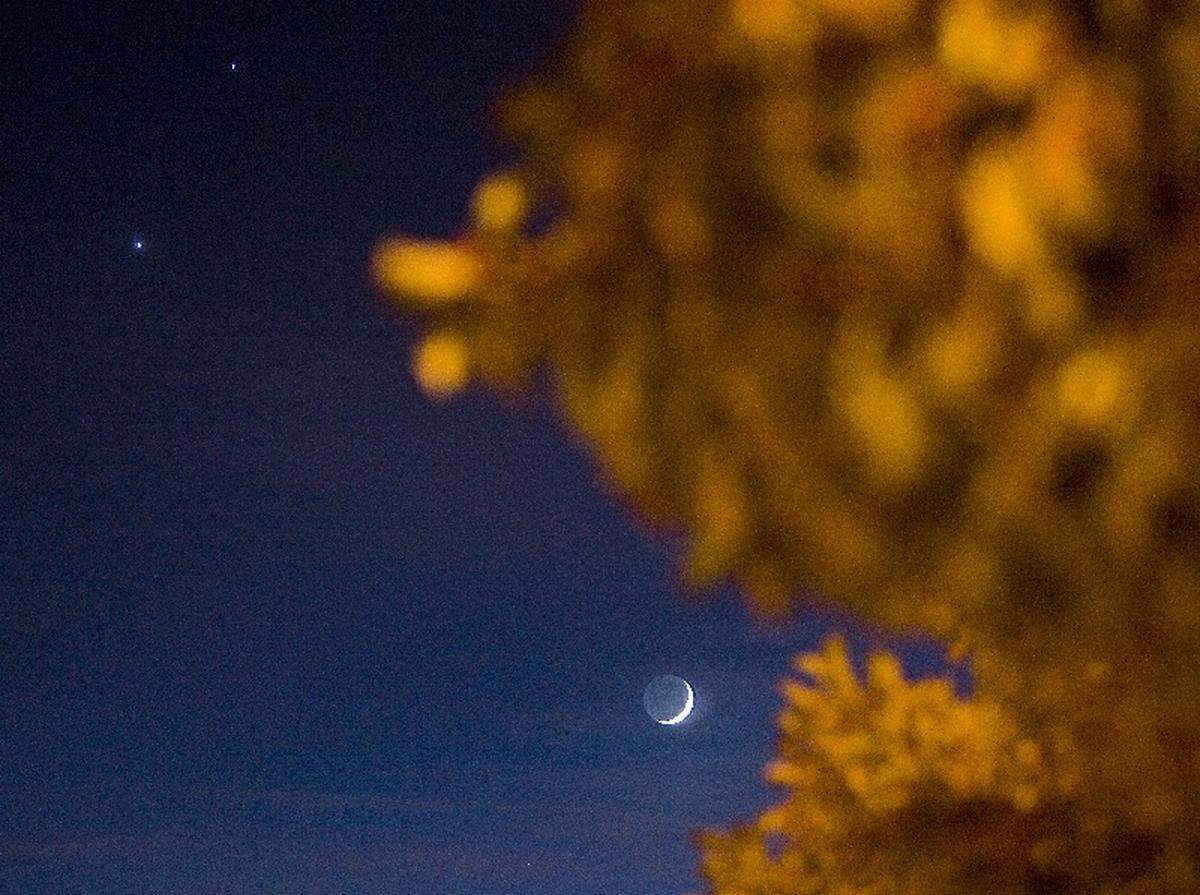
Jupiter will be much easier to spot. It’s the brighter of the two stars and, by early evening, will be visible by looking southward and about two-thirds of the way toward the zenith — the point directly above you. Jupiter will be viewable until about 1:11 a.m. Friday until it, too, sets.
But once the larger planets set, a trio of our closer neighbors will rise above the horizon. Mercury, Venus and Mars all rise in the early hours of Thursday morning between about an hour before the sun rises, meaning you should have about an hour to spot any planets.
Mercury and Mars will be close to the horizon, according to Space.com, meaning they’ll be tough to see. But Venus will be the first planet to rise and, therefore, higher in the sky before sunrise, making it the most accessible planet to spot on Friday morning.
Other full moons this year
If you miss the Wolf Moon in late January, you’ll have 11 more chances to see a full moon in 2024. Here’s the rest of this year’s full moon calendar, according to Astronomy.com:
Feb. 24 - Snow Moon
March 25 - Worm Moon
April 23 - Pink Moon
May 23 - Flower Moon
June 21 - Strawberry Moon
July 21 - Buck Moon
Aug. 19 - Sturgeon Moon
Sept. 17 - Corn Moon
Oct. 17 - Hunter’s Moon
Nov. 15 - Beaver Moon
Dec. 15 - Cold Moon
This story was originally published January 25, 2024 at 7:09 AM with the headline "The Wolf Moon will howl at five planets above WA this week. Here’s how to view them all."