
We must help instill a curiosity about the natural world in our children
The election is over – phew! I am tired of issues, politics and division, and I’m guessing you might be too. So, here’s something different to think about.
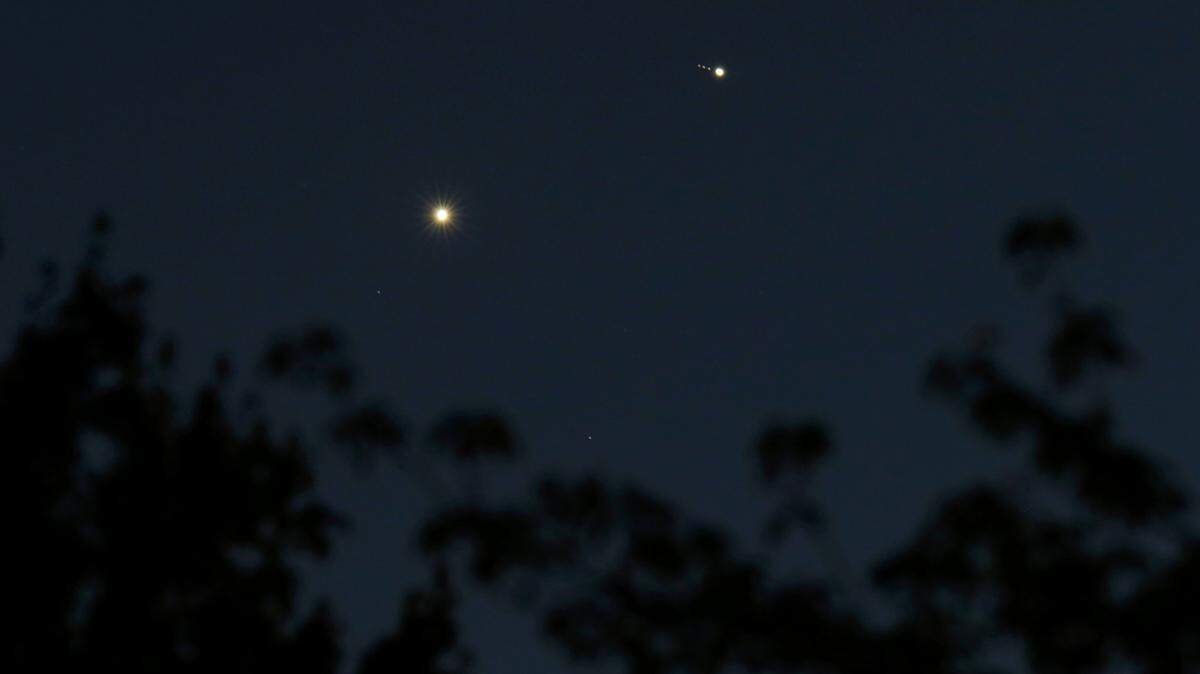
My 19-year-old son Aaron and I were driving home after dark two weeks ago when Aaron spotted a very bright object in the eastern night sky. Must be an airplane, I guessed, but Aaron was not sure. Later he took binoculars and walked down the road looking for an open view. The object turned out to be Mars, which is especially near and bright.
Aaron’s persistence got me thinking about how he became an observer — someone who pays attention. We modern folks tend to live busy lives with little time for observation of the natural world we inhabit. And when we are outside, a good number of us are checking our cell phones or employing ear buds that eliminate sounds like chattering squirrels and birdsong.
That’s why I was so pleased by two recent night sky observations we made together. With clear skies and early darkness, we noted after dusk the planets Jupiter and Saturn in an arc above the southern horizon. That arc is called the ecliptic, an observational arc that the planets travel as they traverse the night sky. Mars, far to the east, is also lined up on the ecliptic and during the recent full moon cycle, Mars seemed to lead the Moon across that night sky arc.
I recently read an article that stated that by 2050, about 70% of the world’s population will be living in urban areas. With more and more light at night, I wonder if future generations will be able to observe and enjoy an actual dark night. Only a few decades ago, everyone was familiar with the night sky and moon phases. A remnant of those times persists when a daily newspaper publishes the phases of the moon, even though few pay any attention to them.
Our vanishing familiarity with the night sky is an example of something that worries me. I fear that with modern life and all its distractions we risk becoming ever more alienated from the natural world and failing to learn to observe our place in the universe.
The modern world, of course, has many advantages. What birds live in our mountains? Your cell phone can provide the answer. What does the African savanna look like? There are PBS nature programs available to show you. But as attractive as these services are, they are not the same as actually making your own observations, experiencing the visceral feeling of seeing and hearing and maybe even smelling real nature.
So, what can we do? I think we need to start with children, and their parents. Many of the parents of today were raised with lots of screen time and probably keep their phones handy. I know most parents value getting youngsters outside. I see some of you pushing the stroller.
While outside, encourage your children to actually observe. When Aaron was young, I carried him on my hip around the yard looking for and naming colors. A few years later we were looking at birds and competing to see who would be the first to notice the moon. By middle school, he was noticing the occasional bald eagle and observing that ravens always seemed to fly in pairs.
If you start early to cultivate observation skills, you can create for your children or grandchildren a curiosity about the natural world. That curiosity can become a lifetime of observing, and a lifetime of learning — part of being completely alive and fully present. We will need future generations to have these skills and interests as humanity faces the unknown challenges ahead.
George Walter is the Nisqually Indian Tribe’s environmental program manager and is a member of The Olympian’s 2020 Board of Contributors. He may be reached at gwalter5665@gmail.com