
Finding the ‘just right’ level of housing density in our community
Finding the right level of housing density is like Goldilock’s search for porridge — too much for some, not enough for others, with that sweet spot of “just right” varying widely.
Yet as our population grows here in Thurston County, we need lots more places for people to live. The state Department of Commerce projects that our county will need another 52,456 homes by the year 2044, roughly 2,622 per year to accommodate our growth. Where should all these new homes go?
Communities use zoning to decide how best to map out where we have stores, schools and factories. When it comes to housing, zoning determines where different kinds of dwellings can be built, designating some areas for apartment buildings as “multi-family” and other areas for one-household housing as “single-family.”
In recent years, some cities have explored ways to create more housing, especially more affordable housing for low- and moderate-income people. One approach has been to increase the “missing middle” — the types of housing that fall between single-family and apartment buildings. The idea is that “gentle density” would allow duplexes and triplexes in neighborhoods previously zoned only for single-family homes.
However, not everyone is a fan. Proponents believe this is a good way to create more homes at a lower price, given the reduced costs in production and energy savings. And many agree that we need more housing in a denser footprint to better use public transit and centrally clustered services such as grocery stores.
Opponents, typically owner-occupants, want to preserve their neighborhood’s character and fight to keep it the same as when they first moved in — single family homes only. Some opponents cite the increases in traffic and parking as too much, while others decry the developers they see as waiting to profit at their expense.
In Olympia, the public debates were punctuated by yard signs proclaiming, “Neighbors for more neighbors” by the supporters and “NO Missing Middle – great for developers, bad for neighborhoods” by the opponents. While this Olympia policy was adopted in 2019, the debate continued, buffeted by several years of legal challenges.
This year, the state legislature settled the debate by passing the bipartisan House Bill 1110, allowing most cities to use “gentle density” as a way to create some of the needed housing. Rep. Jessica Bateman. who joined Rep. Andrew Barkis to sponsor the bill, said, “Over 50 bills were introduced this session related to housing. These were bipartisan and bicameral (both the House and the Senate) and they were all aimed at creating more homes for Washington.”
The zoning maps here in Thurston County’s urban hub show how different the three cities look when it comes to residential zoning and density. Olympia’s map carves out the largest blocks for single-family housing, and historically concentrated its multi-family housing in the southwest portion of the city. Lacey shows a more integrated approach to housing density. Tumwater falls in between, with the east side more integrated than the west side of I-5. Ultimately, local housing density policies now supported by state law will increase the density in all three cities.
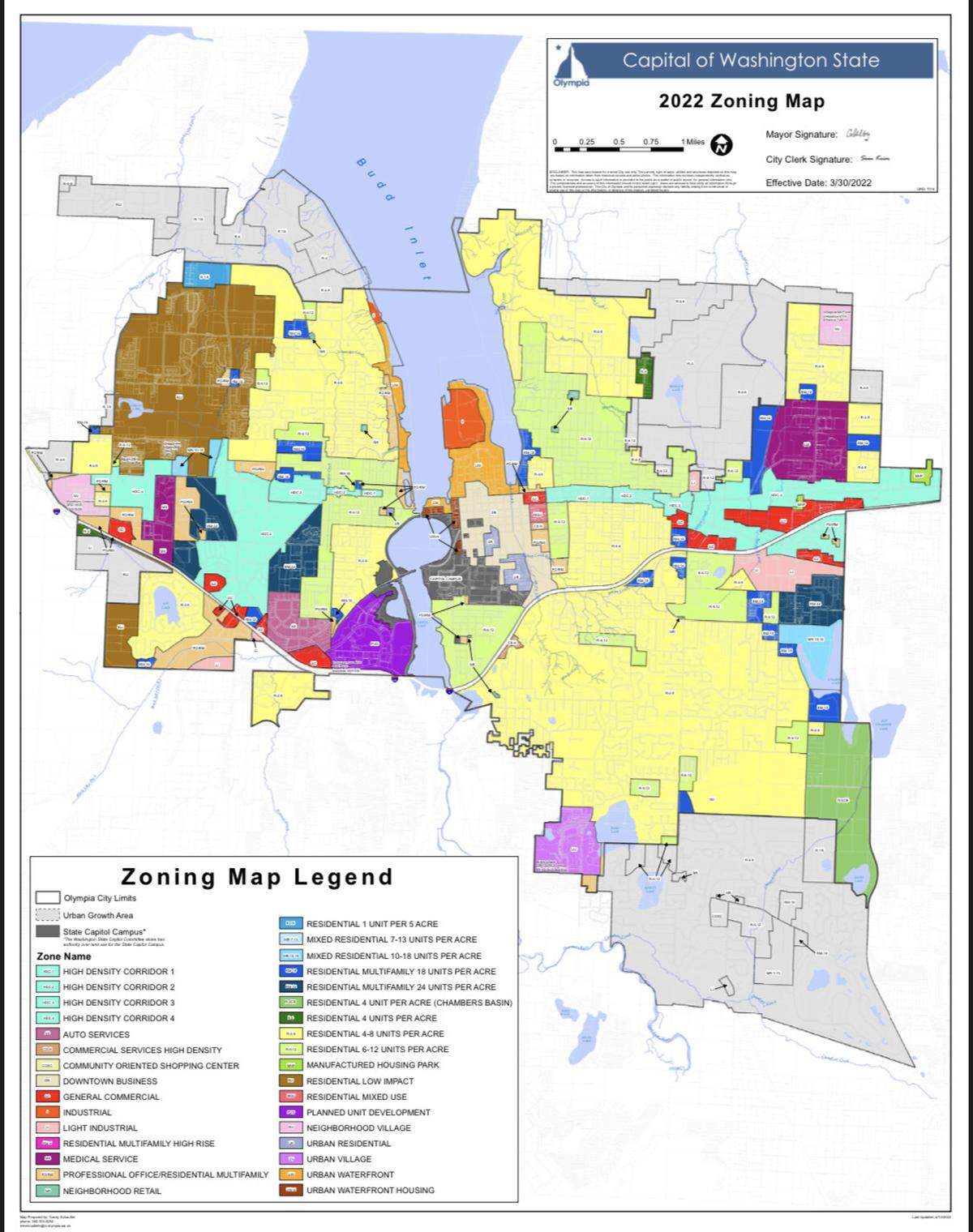
Lacey is a more racially diverse city than Olympia. Some people believe that Lacey’s diversity — with 36% people of color compared to Olympia’s 26% — is the result of proximity to Joint Base Lewis McChord. However, many reports, including the recently released Thurston County Fair Housing Assessment, show that areas zoned multi-family are generally more racially diverse. In this context, housing density becomes a fair housing issue.
Regardless of how people feel about density, Thurston County will continue to grow and the need for more housing will continue to spur new construction. The recent spike in multi-family housing has been a radical departure from decades of the explosive growth of single-family housing developments that have gobbled up forest and farmlands.
For some, the growth of housing density is too much, for others it’s too little. If Goldilocks was an urban planner, she might say this is just right. We need a lot more housing to accommodate all of our neighbors, and that’s no fairy tale.
Anna Schlecht is retired from the City of Olympia where she worked on housing and homeless issues for several decades. This column is part of her year-long exploration of housing issues in our region.