
National Geographic photographer connects people with their wildlife counterparts
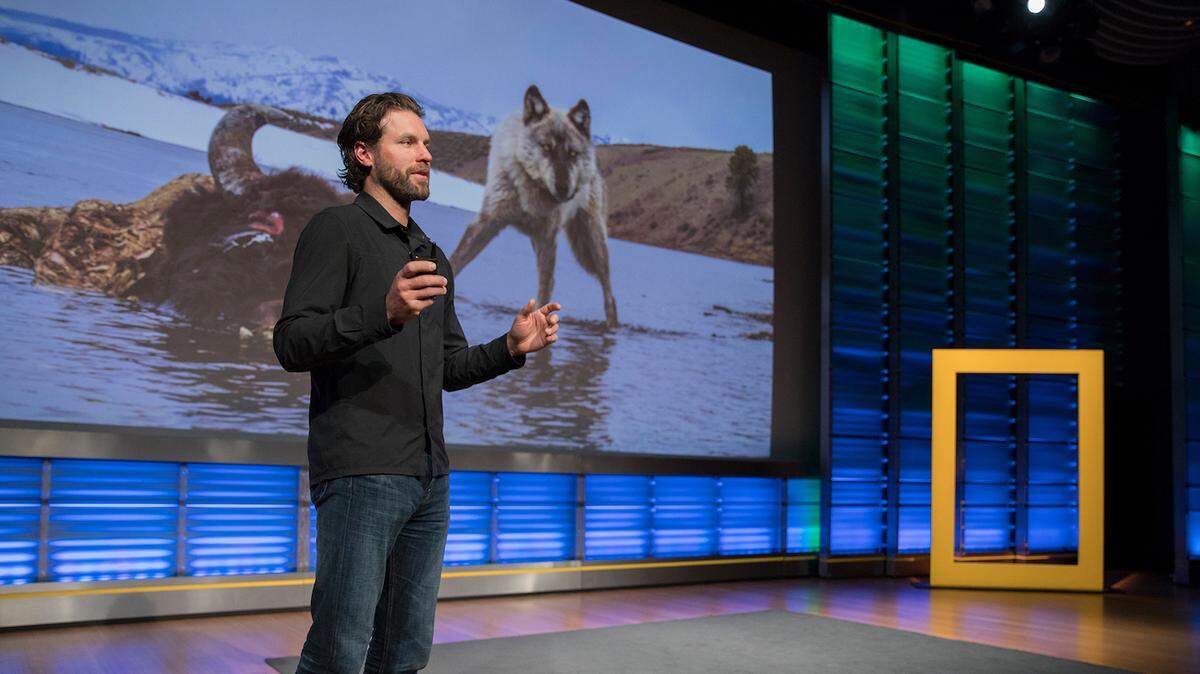
Wildlife photographer Ronan Donovan is an animal.
That statement might sound like an insult, but it’s simply a fact. You’re an animal, too — a social animal not that much different from the wolves and chimpanzees whom Donovan has come to know through his work.
“I was always told that anthropomorphizing was a bad thing,” said Donovan, who’ll speak Saturday in Olympia as part of the National Geographic Live series at The Washington Center for the Performing Arts. “That is too human-centric. It implies that we don’t share the same emotions and behaviors that animals do. We are animals, too.”
Donovan of Bozeman, Montana, began documenting the lives of social animals in 2011, a year he spent photographing chimpanzees in Uganda, climbing into the trees where they spend two-thirds of their lives.
Trained as a field biologist, he’s since worked with wolves, bears and mountain gorillas, using photography and video to do research and tell stories.
He’s documented bears bathing, chimpanzees at rest and the interconnected lives of wolf packs, both in Yellowstone National Park and on Ellesmere Island in the Canadian Arctic.
“These incredible sagas go on in their incredibly short lives,” he told The Olympian. “We just never get to see those. That’s the thing I’ve focused on in the last three or four years — trying to portray these individual characters and telling their stories.”
One such individual was Max, a chimp Donovan got to know in 2011 while working in Kibale National Park in Uganda,
“Max was quite a remarkable case,” he said. The chimp had lost both feet to snares set by poachers trying to capture deer and antelopes.
Not once but twice, Max walked over a spring-loaded trap and wound up with a cable of braided steel tight around his ankle. Both times he pulled the trap from the ground, but the cable cut off circulation, leading to a gradual loss of the limb.
“He received no medical attention,” Donovan said. “The vets couldn’t get there in time. He survived and got on with his life.”
Though they live primarily in the trees, chimpanzees walk miles every day looking for food, something Max does mostly on his hands and knees.
“He finds food,” Donovan said. “He’s able to travel and keep up with his family. I just saw him last year, and he’s sired offspring. He’s basically achieving every goal of a wild male.
“I find that to be incredible to think of an animal surviving that twice and carrying on,” he added. “Without feet, he persisted.”
Such persistence has a lesson for humans, Donovan said. “When animals don’t have any options, they just get on with life.”
“Modern humans have gotten so far away from the connection to our wild counterparts,” he said. “As a whole, we don’t see animals as being intelligent. … There isn’t that baseline understanding that a lot of traditional societies had. They respected the other living beings that we share the world with.
“Humans and wild animals have lived side by side for eons, and today, we’re trying to figure out ways to continue that.”
National Geographic Live: Ronan Donovan
- What: Photographer Ronan Donovan, who documents the lives of social animals such as chimpanzees, wolves and bears, will share his images and speak about his work.
- When: 2 p.m. Saturday
- Where: The Washington Center for the Performing Arts, 512 Washington St. SE, Olympia
- Tickets: $25-$40
- More information: 360-753-8586, washingtoncenter.org