
Splendor in the grass: Parks open just in time for prairies’ peak wildflower season
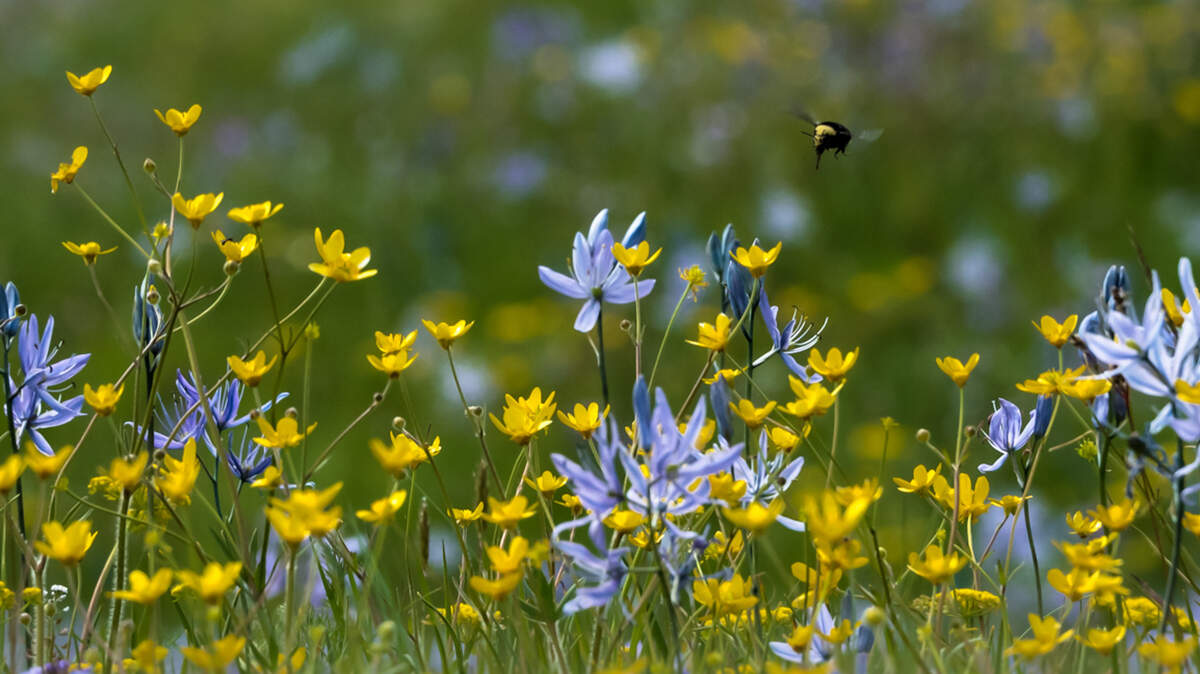
The camas are in full bloom on Western Washington’s prairies.
“It’s just a sea of blue,” said Sabra Noyes of Friends of the Puget Prairies. “And then there is a tremendous array of other wildflowers.”
And with many parks and recreation areas open once again, you can seize the moment and see the scenery live and in person as well as online.
Until coronavirus concerns forced its cancellation, Saturday was to be the 25th annual Prairie Appreciation Day celebration, an event timed to showcase the peak of the wildflower season on the prairies south of Olympia.
But just as it didn’t stop the flowers from growing and the birds from singing, the pandemic didn’t put an end to the celebration of the prairies, often overlooked in this land of forests and shorelines. It just transformed the celebration.
“We decided to do a virtual appreciation of the prairie that will last a full year,” said Dennis Plank of Littlerock, a longtime organizer of Prairie Appreciation Day.
The Friends of Puget Prairies’ blog will follow the rolling meadows through the seasons in words and images and include personal stories as well as scientific information.
If you’d like to appreciate the prairies in person, you can visit Mima Mounds Preserve and Scatter Creek Wildlife Area, both open for day use only. As at all reopened parks and recreation areas, visitors must maintain a social distance. (The Glacial Heritage Preserve, normally open to the public only for Prairie Appreciation Day, will remain closed.)
Besides the camas, the signature plant of Washington’s prairies, Plank recommends looking for balsamroot, whose blossoms resemble sunflowers but are low to the ground; buttercups; spring gold; goldenrod and violets.
“Violets are very abundant this year,” he told The Olympian. “The blue prairie violet is the main one they’ll see.”
Also abundant are birds, including tree swallows, violet green swallows, Savannah sparrows, white-crowned sparrows and perhaps even bluebirds, though those are most often seen at Glacial Heritage.
Those who visit the prairies might want to be prepared for the possibility that they’ll fall in love. Both Plank and Noyes were drawn to the prairies at first sight, so much so that both wound up living on prairie land.
“It’s like everybody has their favorite artist or their favorite musician,” Noyes of Oakville told The Olympian. “Renoir really resonates with me. And I love Mozart. I don’t know why the prairie resonates with me, but it does.”
“It’s like being able to go to a whole different world when you leave the city or leave the forest and come out to a prairie,” Plank said. “You can look across a mile or so and see trees on the horizon, and the sky is wide open, so it’s a different feel and it’s one that I really enjoy.”
Plank also met his wife, Michelle Plank, on the prairie. Both did volunteer work at Glacial Heritage beginning in the late ’90s, though they didn’t get together romantically until 2005.
Plank planned a trip to the Othello Sandhill Crane Festival and started looking for others who were interested.
“She was the only one that responded,” he said. “We carpooled over together, and we found out we were really good traveling companions, and it just went from there.”
One year later, they married, and they now live on their own patch of prairie not far from Glacial Heritage.
Prairies to visit
Mima Mounds Natural Area Preserve, 12315 Waddell Creek Road SW. A Discover Pass is required. 360-577-2025, http://www.dnr.wa.gov/MimaMounds or http://www.wta.org/go-hiking/hikes/mima-mounds
Scatter Creek Wildlife Area, 183rd Avenue SW, Rochester. A parking permit is required. http://wdfw.wa.gov/places-to-go/wildlife-areas/scatter-creek-wildlife-area or http://www.wta.org/go-hiking/hikes/scatter-creek
This story was originally published May 7, 2020 at 5:45 AM.