
Residents at odds over proposed YMCA camp at Mineral Lake
Ron Nilson has watched hundreds of people stop in front of his home to take the same photo: beautiful Mineral Lake, a hidden gem surrounded by dense trees with Mount Rainier towering in the background.
Last week, the lifelong resident pointed to a “Discover Lewis County” postcard featuring the same shot, warning that much of that beautiful landscape off state Route 7 southeast of Elbe could soon be “destroyed.”
Nilson was talking about a planned youth camp by the YMCA of Greater Seattle, which is petitioning Lewis County to rezone much of the land around the lake. The proposal sparked some uneasiness in 2020, and now, a year later, as more details have emerged, opposition has shifted and important players have provided their support.
After passing out a petition against the camp last week at a county meeting, Nilson declared that increased pollution is inevitable and “Seattle, et cetera, wants to own” some of the waterfront property “for their greed.”
“The land and its resources should be for the benefit of all citizens and not just the privileged few,” the petition reads.
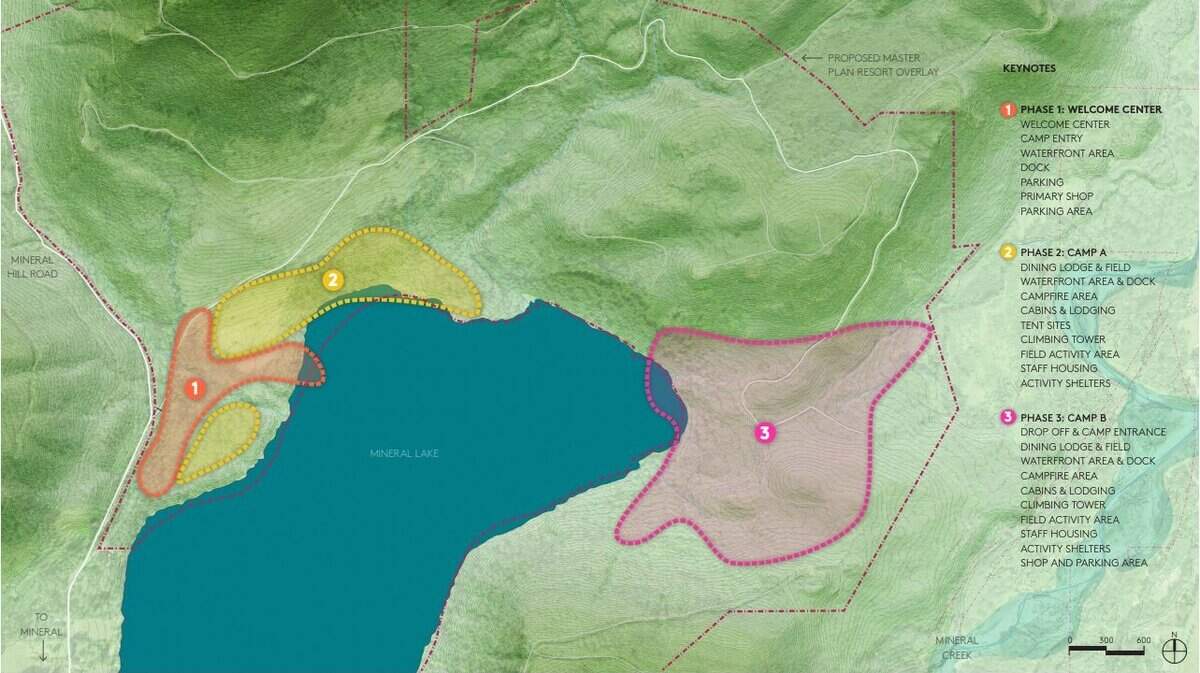
YMCA of Greater Seattle paints a vastly different picture. Of the 643 acres it’s trying to rezone around the lake, only about 10 acres would be developed.
And despite the desired “master planned resort” zoning designation, the plan is to build rustic cabins and a lodge over the course of several years. Ultimately, the camp would accommodate as many as 400 campers and 100 staff.
The application also contends that rezoning would actually “allow for greater environmental protections along Mineral Lake,” providing a “visual and natural buffer” along the waterfront from more intensive logging practices.
At a recent Lions Club meeting in Mineral, YMCA staff tried to assuage concerns voiced by locals, assuring them that campers will use canoes or kayaks, not motorized boats; most of the land will remain unchanged; jobs will be created, and questions of water availability and traffic will have to be addressed for the project to progress.
“We don’t take kindly to outsiders coming in and changing our way of life,” one participant said.
Many residents who spoke up described worries that the small town of just over 200 would be drastically changed.
But recently, the camp garnered support from the Lewis Economic Development Council, with executive director Richard DeBolt saying it aligns with the EDC’s interest in projects “that improve the local quality of life.” Lewis County, he said in a YMCA news release, “would benefit from a community-focused organization such as the YMCA.”
The Nisqually Indian Tribe also would benefit from the camp, which would offer expanded access to tribal members for traditional and cultural uses.
In the same release, Nisqually Tribal Council Chair Willie Frank III said the land is sacred to the tribe, which is excited to partner with the YMCA “to create a Native American program and environmental education center to share our ways and to protect mother earth for the seventh generation.
“We also recognize that the more people know about our natural world, the more likely they are to protect it,” Frank III said. “Education is absolutely key to our future.”
It would be the YMCA’s first new overnight camp in over a century – something the organization says there’s a growing need for, saying it wants to get kids off waitlists and out into nature.
According to the county’s community development director, Lee Napier, the ball is currently in the YMCA’s court. Public comments have been collected, and the nonprofit now has the opportunity to address residents’ concerns.
The YMCA’s proposal will come before Lewis County’s planning commission at a future date not yet determined, Napier said.
The way Lions Club member Dick Suter sees it, opponents of the project may be vocal, but the majority of the town is undecided on the issue.
The lifelong Mineral resident said many concerned residents are newcomers who moved to Mineral looking for peace and tranquility.
But Suter said a new camp “would certainly help whatever little business Mineral has.”
For Brian West, owner of nearby glampsite “Elkamp,” the YMCA seems like a “perfect progress partner” for Mineral.
West worked in youth camping for several years and said he understands the importance of getting kids out in nature. Plus, the camp could welcome a more diverse group of people into the unincorporated town that’s “a little too homogenous,” in his opinion.
But that prospect, West thinks, is also what’s behind some of the local opposition.
The lake already participates in a state-run fishing derby, boasting its self-proclaimed title as “home of the 10-pound trout.”
That event, West said, includes participants that “cram the lake full of gas and beer cans.”
“That’s a lot more damaging to the lake and the environment and our area than a couple hundred kids would be canoeing.”
The question of access also elicits varying responses. While some feel the camp will push locals out of the lake – a quintessential part of the fishing community – others say the body of water is underused, and that the camp could only improve accessibility.
Traci DeWitt, whose Elbe Junction is just a few minutes from Mineral lake, told The Chronicle a camp could be great for kids who don’t have the opportunity to recreate in such a beautiful place.
But she wants to make sure the relevant local agencies are included in development plans and that the YMCA does its due diligence. She hopes another, bigger community meeting can help “calm some of the unknowns.”