Ex-baseball player, Pac-10 and NFL ref, Tacoma parks backer Aaron Pointer to be recognized
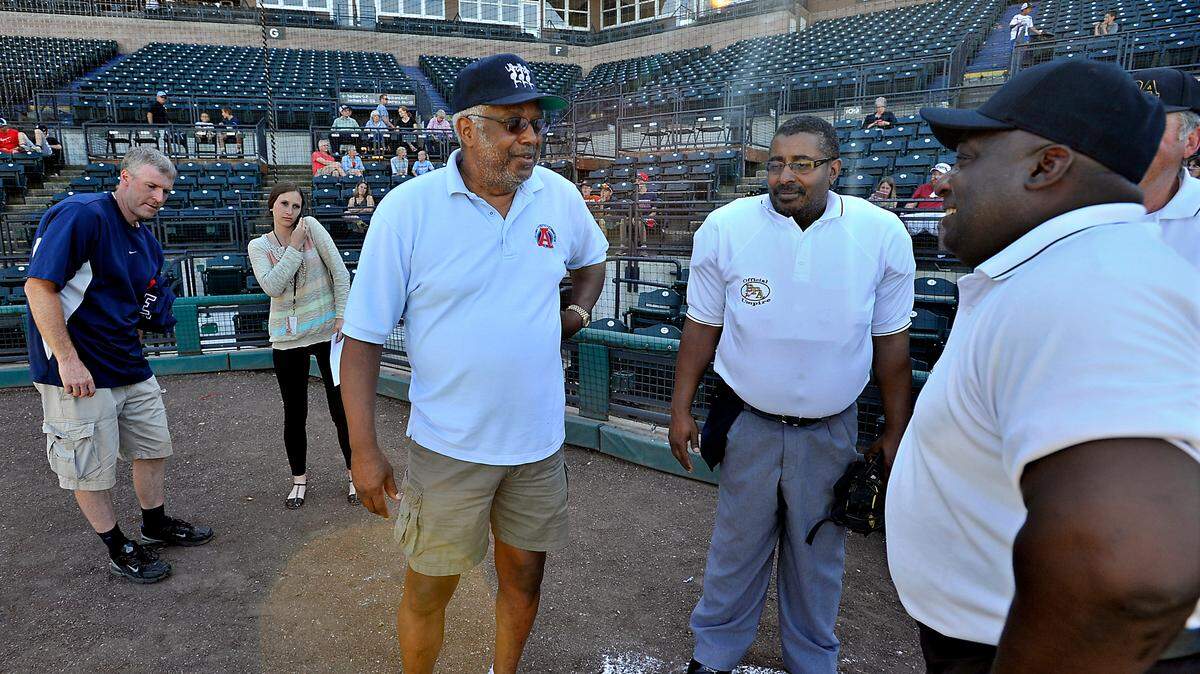
Aaron Pointer’s life reads like a Hollywood script. The story unfolds in Oakland, where Pointer grew up in parks and on basketball courts, playing neighborhood games against guys like Bill Russell and Mike Farmer. Then, two years at the University of San Francisco, playing basketball and baseball. There’s young love: He met his wife, Leona, in college. They’re still married to this day.
Then, act two: A professional baseball career, where Pointer hit over .400 in a season — though he did it as a minor leaguer, he’s still the last pro baseball player to accomplish that feat — while facing the ugly reality of segregation in the South for the first time in his life. The story spans the globe, with years playing professional baseball in places like Japan and Venezuela.
If the story were to stop right there, it’d be a quality coming-of-age story. But this story rolls on: Pointer became the first Black referee in the Pac-10, then an NFL referee for 17 years. The best part? Much of the story takes place right here, in Tacoma, where Pointer has lived with his family since 1973.
Pointer is one of two people who will be recognized with the Doug McArthur Lifetime Achievement Award at the 2020 ‘Tribute to Champions’ Hall of Fame event, put on by the Tacoma Athletic Commission and Shanaman Sports Museum (last year’s event was canceled due to covid). And what a life it’s been.
THE EARLY DAYS
It was all sports, all the time growing up in Oakland, California.
“I remember growing up in kind of a happy, athletic atmosphere,” Pointer said. “We didn’t have cell phones. We played sports whenever we got the chance.”
Pointer played mostly basketball and baseball. There was no shortage of talent on those outdoor courts, either. Guys like Russell and Farmer, who went on to star in the NBA, were regulars.
“A lot of those guys that played pro ball were our mentors,” Pointer said. “I just remember it being a fun time in our lives, testing yourself against other guys, trying things, getting out and having a good time.”
Pointer said they didn’t have much. No fancy equipment or anything like that. But with his friends, he was happy. In the summer, they’d play sports from early in the morning until late at night, when the darkness finally made it impossible to continue.
“We’d have to fix bats that were broken,” Pointer said. “Balls would get shredded; we’d just put some tape on them and continue to play.”
He went to the University of San Francisco on a basketball scholarship in 1959. He played both basketball and baseball there, but he was on a hoops scholarship. Baseball players didn’t receive full rides. Pointer met his wife there in 1961. A year later, they were married.
A SLICE OF HISTORY
Pointer left college early and signed a baseball contract with the Houston Colt .45’s (later renamed the Astros) in 1961. The club assigned Pointer to their Class D team, the Salisbury Braves, in Salisbury, North Carolina.
When he stepped off the plane for spring training in Jacksonville, Florida, Pointer was in for a rude awakening. The first thing he saw was a big sign: ‘COLORED.’ It was his first time experiencing that type of segregation.
“All of the Black players stayed in this crummy-ass, un-air conditioned motel,” Pointer said. “The other players stayed in air-conditioned hotels.”
Once they broke spring training and Pointer went to North Carolina, it was more of the same. He had trouble finding housing as the only Black player on the team.
“I lived out of town in a motel, bought a car there and then had to drive to the games,” he said. “That was the only way to get there. Being the only Black player, I was by myself. It was tough.”
The team would go on road trips to play away series and stop for a bite to eat. Pointer would have to wait outside, not allowed to go inside the restaurants. He’s thankful for a teammate named Tommy Murray, who befriended him. He’d bring food to Pointer on the team bus.
“It was not a happy time for me,” Pointer said. “Growing up in Oakland, there was segregation and discrimination, but I never noticed it because the community where I grew up was like 70 percent black. The high school I went to, there was one white guy. Everybody was black. You never really faced segregation. Some parts of town, you knew not to go into, but I never wanted to go into them anyway, because I was having so much fun in my own neighborhood.”
He couldn’t use the same bathrooms as his white teammates, couldn’t go to bowling alleys. If he wanted to see a movie, there was an entrance in the back for Black people, and they’d have to watch the movie from the section upstairs. He struggled to find places to even eat or buy groceries.
“I don’t know how I would’ve gotten through it, if it wasn’t for baseball,” Pointer said. “I couldn’t have lived in that part of town in that situation much longer than I did. It was tough. I spent five months there in Salisbury. It was not easy.”
He’d hang out at the ballpark after the game as long as he could after games, just to avoid driving back to the motel outside of town and being alone.
When Pointer got called up to the Triple-A team in Houston, he put on his best suit and tie, waiting in a hotel in Houston for the team bus to show up. A man drove up to the hotel entrance and tossed Pointer his car keys, assuming he was the hotel valet.
“I didn’t say anything,” Pointer said. “I just took the keys, put them in my pocket, got on the team bus and on my way to the ballpark, I just threw the car keys out of the window on the freeway. It’s one of the things I’ll never forget.”
Despite the segregation and discrimination, not to mention the anger and sadness that stemmed from that, Pointer put together a remarkable season on the baseball field with the Salisbury team. Going into his final game of the season, his average stood just over .400. His manager asked if Pointer wanted to sit the game out. If he failed to collect a hit, his average would drop below .400.
“I said, ‘What’s the big deal? No, I want to play,’” Pointer said.
He went 2-for-3 that game and ended the season with a .402 average. Still, Pointer is the last pro baseball player to hit over .400. In 2005, an infielder for the New Orleans Zephyrs named Rick Short was hitting .400 late into the season. A reporter from New Orleans called Pointer to ask his thoughts.
“It didn’t really register that it was something special (until then),” Pointer said. Short ended the season with a .383 average.
Pointer was traded to the Chicago Cubs in 1968, and reported to the Tacoma Cubs, Chicago’s Triple-A affiliate at the time. That was his first time in Tacoma.
INTERNATIONAL TRAVEL, A REFEREE CAREER AND A LOVE FOR LOCAL PARKS
Pointer went on to play professionally in Japan and Venezuela, before retiring from baseball and returning to Tacoma. He got a job as the Pierce County Parks director of recreation and began officiating baseball, basketball and football.
He got a chance to try out as an official for the Pac-10, and he made it in 1978, becoming the conference’s first Black official.
“I liked football because you’re officiating with crews,” Pointer said. “After the game, you go out to a tavern, have a beer, talk about sports and what not. So football was kind of my thing.”
In 1987, he was encouraged by a friend in the officiating business to interview for an NFL position. He did, and went on to be an NFL official for 17 years.
“I really enjoyed it,” he said. “It was a good place to officiate.”
Pointer currently serves on the board of Metro Parks Tacoma, after a 30-year career as the Pierce County Parks athletics supervisor. He said he’s honored to receive the lifetime achievement award, named after Doug McArthur, who shared a similar love for sports and recreation during his career.
“I think it’s a big deal,” Pointer said. “Doug, he and I had a lot of things in common. Mainly parks, he was a big promoter of parks. When he had the Dune Peninsula park that we finished a couple years ago, Doug would email me and say it’s the best park in the country. … He was all for parks, community, kids.”
THE REST OF THE HONOREES
Brian Kamens, who served as the supervisor and lead historian for over a decade at the Tacoma Public Library’s Northwest Room, is also being honored with the Lifetime Achievement Award.
- Frosty Westering Excellence in Coaching Award: Don Gustafson, Life Christian Academy girls golf; Joe Waters, Bellarmine Preps boys soccer.
- Dick Hannula Male and Female Amateur Athlete of the Year Award: Morgan Weaver, soccer, Curtis, WSU; Malachi Flynn, basketball, Bellarmine Prep, WSU and San Diego State
The 1987-2000 sports staff of the Tacoma News Tribune is also being inducted into the Tacoma-Pierce County sports Hall of Fame, in the media category. Find the fill list of inductees on the Banquet of Champions website.

The banquet will be held on Monday, Aug. 23 at the Greater Tacoma Convention Center from 5:30 to 8:30 p.m.
This story was originally published August 22, 2021 at 5:00 AM with the headline "Ex-baseball player, Pac-10 and NFL ref, Tacoma parks backer Aaron Pointer to be recognized."