
From illiterate to author, former Sonics forward Dean Tolson writes the story of his life
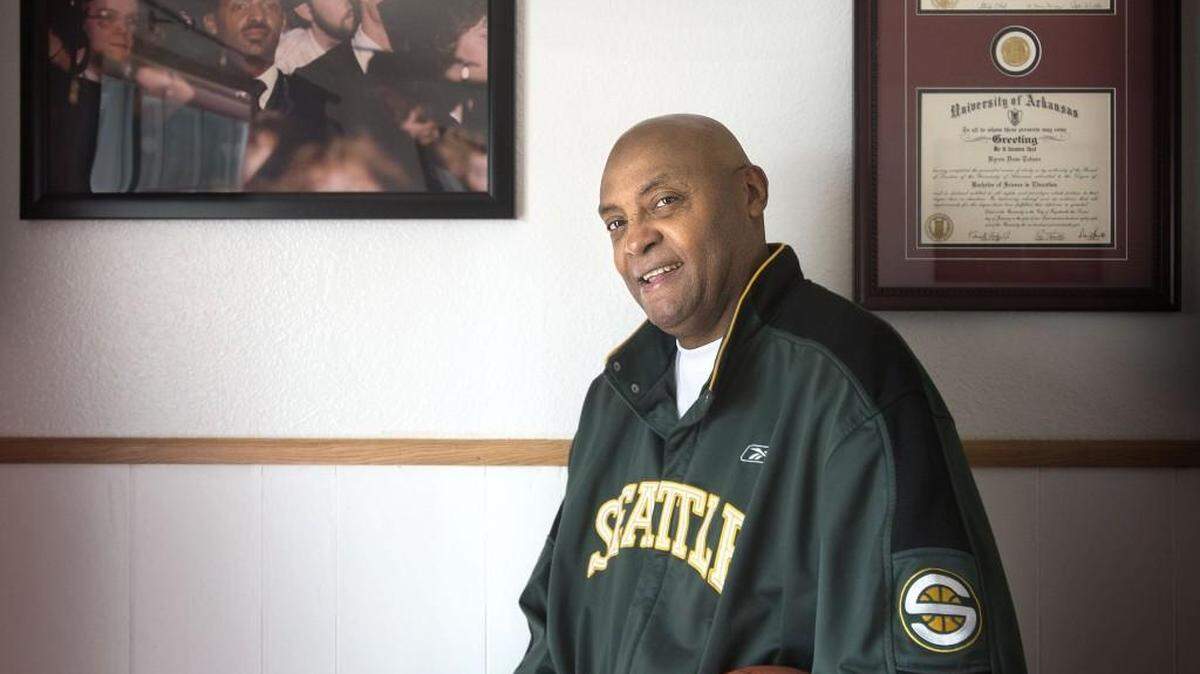
Who better to write a book about the value of education than a man who struggled much of his life to hide his illiteracy?
Who could more convincingly warn youths that sports aren’t forever than a man who excelled in college basketball, yet had only a fifth-grade education to fall back on when his NBA career with the Seattle SuperSonics ended?
“Nobody’s ever heard a story like this,” Dean Tolson said. “Every kid in America should hear this story because it’s about the value of an education.”
Tolson has spent 10 years writing a biographical manuscript and is in the process of submitting it to publishers.
The title “The Magna Cum Laude In Me” foreshadows the way Tolson finally returned to the University of Arkansas, studied almost around the clock to earn his bachelor’s degree at age 36 and eventually received his master’s degree with high honors at age 55.
With his education in hand, and some money from his years playing international basketball, Tolson established and operated a carpet-cleaning business in Tacoma for 20 years.
Now retired at age 64, he works on his book and continues to spread his cautionary tale to youths through numerous school appearances.
“There’s no better feeling than somebody coming back to me 10 years later and saying, ‘Dean, I heard your story, and now I’m a doctor, a lawyer, a teacher,’ ” Tolson said.
Tolson’s life has enough drama to fill a book, with too many details for a newspaper feature. So the story here is mostly about his fighting back, finding the right path and being motivated enough to prove that it could be done.
As Tolson recited his oral history in his north Tacoma home, he did so with the flair of a showman and a sincerity so intense it sometimes brought him to tears.
It starts out like a Dickens tale of poverty and abandonment. His single mother surrendered her three eldest children to an orphanage because she couldn’t support all five, despite working three jobs. From ages 9 through 14, Tolson lived in a state home that “made a man out of me (because) you had to fight every day.”
Reed thin, he lost most of those fights, and he became “a very nervous kid,” with trouble focusing in school. After being held back in fifth grade, he eventually was incrementally shuffled through the system, mostly because he was so much taller than every kid in class.
Along the way, he was called “Big Dummy” and worse, he recalled. His escape route from the violent and crime-filled environment in “the ghettos of Kansas City” became obvious when he sprouted to 6-foot-8 in high school and become an All-State basketball talent. He was recruited by dozens of top colleges, but all except one lost their interest when they saw his 1.8 GPA.
Arkansas was the only university to sustain interest, and he gained admission after another student took his entrance exam for him.
While becoming the school’s leading rebounder and enjoying scoring outbursts like his 45-point night against Texas A&M in 1974, Tolson paid no attention to school work, and he remained eligible due to “gifts from some professors.”
“Of course they were gifts, I had a fifth-grade education,” he said, citing a transcript that was a series of “Fundamentals of … ” classes. Fundamentals of Golf. Fundamentals of Basketball. Fundamentals of Ballroom Dancing.
“On my 124-hour transcript, from ages 18 to 21, I had 80 hours of ‘F.’ ”
With academic standards ignored for the star player, Tolson remained eligible, and as a senior during the 1973-74 season, he averaged 22.5 points and 13.2 rebounds a game.
The Sonics took him in the fifth round of the NBA draft. He was cut and re-signed several times, playing in 80 games over three seasons in the process. His best stretch came in 1976-77, when he averaged nine minutes and six points a game.
And that was it.
As for the riches everyone expects to result from a pro basketball career, Tolson’s first contract with the Sonics paid a mere $17,000.
Without an education or alternative job training, Tolson turned into a basketball vagabond, playing in pro leagues across the world.
Even at 32, in 1983, he was earning money from international basketball. But when he stopped in Kansas City to see his mother before heading back to his team in Greece, he received a cool welcome.
“I walked into the house with a basketball under my arm,” he said. “I’ve got my passport and my plane ticket back to Greece, and my contract in hand for $40,000.”
His mother didn’t make her point at the time, but she secreted the passport and ticket from his bedroom and hid them. It wasn’t until Tolson readied to head to the airport that he discovered their absence.
Standing to reenact the pivotal moment of his life, Tolson assumed his mother’s distraught voice. “You look so awful to me son, you’re 32 years old and you’ve still got that basketball under your arm,” he recalled her saying. “You’re dumb as a doornail, with no education, and I am ashamed of what you are.”
Ashamed? Tolson didn’t understand why and argued that he was making his own way in life, earning a living doing what he loved, and not asking anybody for handouts.
She stood her ground for several days, refusing to return his tickets, and finally told him what she wanted.
Tolson took on his mother’s voice again, but the tears he started crying were his own. “I’ve never asked you to do nothin’ for me, none of you. But I want you to do this one thing for me: go back to school and try to learn for the first time in your life.”
Tolson paused to collect himself, the pain still fresh.
He realized she was right, and he knew whom to call. He went to the phone and called Arkansas athletic director Frank Broyles, who had been the school’s legendary football coach.
Tolson said that ever since that day he’s seen Broyles as a “godsend and a great man” who helped him change his life. Broyles arranged for the school to pay Tolson’s tuition and board if he dedicated himself to the task. Tolson said Broyles explained the university’s obligation to him: “We robbed you of an opportunity to get your education.”
Broyles opened the door, but Tolson needed help from there. He found it in Marcia Harriell, a tutor who unsparingly committed to his academic revival.
“He could read some, and he could write a little, not script, but elementary school letters,” Harriell said of her first meeting with Tolson. From the start, she made him read every chapter aloud, and along the way she would go over the word meanings and pronunciations.
“I was always nearby … correcting,” she said. “It was a process of constant learning and correction.”
Harriell alternately was tutor, mother-confessor and psychologist. “When I first started tutoring him, he was carrying a lot of past hurt and was very frustrated; at times he would start crying,” she said. “I would let him talk and get that all out, and we’d take a break and we’d come back to work. Gradually, over time, he was able to get that top layer of emotion out.”
Harriell confirmed Tolson’s recollection of daily study periods of up to 15 hours as he spent four years and two summer sessions making up credits and raising his 1.4 GPA above a 2.0 to earn his bachelor’s degree.
“I don’t know of anybody, personally, who had that level of dedication or drive,” Harriell said. “That’s what kept me going. He wanted to do this so badly that I couldn’t have turned him away.”
In 1988, Tolson was featured in a Sports Illustrated story; not about his flamboyant dunks or a great athletic career, but as an example of the embarrassing lack of academic standards in college sports. The story’s happy ending was the way Tolson became so dedicated to changing his life.
Nearly 20 years after getting his bachelor’s, Tolson challenged himself again, going back for his master’s in adult education, a program in which he earned 10 “A” grades against one “B.”
Along with his graduation robe in 2007, he wore the special ribbon designating his magna cum laude standing.
Since then, Tolson has been generous in sharing his experiences and his message of academic revival.
Willie Stewart, who spent 36 years as teacher and administrator in Tacoma schools, came away from a Tolson presentation impressed by the message and delivery.
“So many people who have been through experiences like he was are shy about talking about it,” Stewart said. “But he allowed himself to be vulnerable and open. He captivated them. He was open and sincere and he moved them.”
Author Gerald Hausman has worked with Tolson on his memoir and has been struck by Tolson’s ability to connect with youths.
“He’s just an amazing person,” Hausman said. “Some people would have bottled all this inside him, but he’s completely honest, and he tells a story that is unvarnished and real. I think it will really help kids who are in tough situations now. Kids can tell when people aren’t genuine, so they appreciate it when he says, ‘This is what happened in my life. I won’t kid you, I had a tough life.’ ”
The heart of the message, he said, is that it took him decades to realize that education is an opportunity, not an obstacle.
“The story I want to tell is that we all do good things and bad things; I did things the wrong way, and then I did it the right way,” Tolson said. “That’s being human.”
And for Tolson, it was like earning a degree in life.
Dave Boling: 253-597-8440, dboling@thenewstribune.com, @DaveBoling
This story was originally published July 4, 2016 at 6:42 PM with the headline "From illiterate to author, former Sonics forward Dean Tolson writes the story of his life."