
The World Cup shocks and upsets that echo to this day
World Cups are frequently remembered for magnificent goals, heroic performances and famous wins, but shocking results play a huge role in our collective memory of the tournaments too. Will any of the matches in the 2026 tournament, which begins in less than three weeks, join this list?
USA 1-0 England, 1950
It is difficult to fully explain the vast difference in expectations for England and the United States going into the 1950 World Cup, held in Brazil.
This was England’s first World Cup appearance after having boycotted the first three editions, but England remained convinced that its soccer was the strongest in the world. Its team included legendary players such as Billy Wright, Tom Finney and Stan Mortensen, all among the greatest in the world at their positions, as well as defender Alf Ramsey, who would manage England to World Cup success 16 years later.
Soccer in the United States had yet to take off, and the hastily assembled side was managed by William Jeffrey, a Scot whose day job was coaching the Penn State University team. The players were amateurs; some regular first-teamers could not travel because of the demands of their day jobs.
But the United States went ahead shortly before halftime when Walter Bahr attempted a hopeful shot from long range. The ball flicked off the head of forward Joseph Gaetjens and bounced into the net. There were varying interpretations of how intentional the touch was, but Gaetjens -- a Haitian who never became a U.S. citizen and who never played for the U.S. men’s national team again after this tournament -- had scored one of the most famous goals in soccer history.
From there, the United States defended deep and in numbers, with goalkeeper Frank Borghi taking particular credit for his aerial dominance. England seemed set to equalize on a strong chance from Mortensen, only for U.S. defender Charlie Colombo to perform a tackle more suited to rugby than soccer.
It was “the latest and biggest upset in the world soccer championship,” The New York Times reported at the time. “Brazilian fans swarmed onto the field after the United States victory and took the Americans on their shoulders.”
Ultimately, both teams went out in the group stage. But the U.S. win remains one of the most unlikely in World Cup history.
North Korea 1-0 Italy, 1966
When North Korea shocked Italy in 1966, the only parallel the English sports writers in attendance for the World Cup in their country could find was that United States win 16 years earlier.
Serie A was, at this stage, the richest league in the world. The two Milan clubs had enjoyed an excellent few years in the European Cup. Giacinto Facchetti was perhaps the best left back of all time. Sandro Mazzola and Gianni Rivera were among the best attackers in the world. This team would win the European Championship two years later, then reach the World Cup final in 1970.
On the other hand, no one knew much about North Korea as a country, never mind a soccer team. This match was expected to be a formality.
This was the final World Cup before substitutes were introduced, and that was significant: Italy lost Giacomo Bulgarelli in the first half to a serious knee injury. Unable to call upon a replacement, the Italians played the rest of the game with 10 men. Where North Korea could compete was in terms of fitness, which surprised an Italian team that tended to play at a leisurely pace and wait for counterattacking opportunities. Italy had the better of the game, but Marino Perani missed a stream of chances.
The goal came somewhat out of nothing -- a simple aerial battle meant that the ball bounced invitingly for Pak Doo-ik on the edge of the box. He swiveled and fired into the far corner. Italy, rattled, struggled to mount a comeback, and its one-man disadvantage became even more obvious.
What made this upset all the more momentous is that, unlike the others on this list, the result was genuinely significant. This was the final group game, and North Korea progressed at the expense of Italy, which was eliminated and returned home to be pelted with rotten fruit by angry fans.
Thirty-six years later, when South Korea faced Italy on home soil, fans held up banners referring to North Korea’s 1966 success. South Korea recorded a 2-1 win that day -- a result almost as unexpected as this one.
Cameroon 1-0 Argentina, 1990
Argentina had won the World Cup in 1986 in memorable fashion thanks to the brilliance (and skulduggery) of Diego Maradona. Cameroon was appearing in only its second World Cup. The 1990 opener at Milan’s San Siro seemed like it would be a fairly straightforward win for Argentina.
Cameroon started nervously and was a little fortunate that the game was goalless at the break, although it did have chances -- Argentina defender Nestor Lorenzo had to clear off his line at one point. Cameroon had two excellent players: Thomas N’Kono was a genuinely world-class goalkeeper, and Francois Omam-Biyik was always a threat on the break.
Equally, the game plan, really, was about physicality. Cameroon had two players sent off, both for fouling halftime substitute Claudio Caniggia. If Maradona had received the majority of the physical attention at the 1986 World Cup, here it was Caniggia’s turn. First Andre Kana-Biyik was shown a straight red card for tripping. Later, the most memorable moment came when Caniggia broke over the halfway line, speeding past a couple of challenges before finally being upended by a foul from Benjamin Massing, which would likely bring a straight red card in the modern era but merely earned a second yellow here.
In between those two incidents, Cameroon scored. It was a terrible goal: a weak free kick from the left that was sliced into the air by Lorenzo, and Omam-Biyik outjumped Roberto Nestor Sensini in trying to get the ball. His header was on target, but it was a major surprise that goalkeeper Nery Pumpido misfielded the ball. His tournament did not get any better: He broke his leg 11 minutes into Argentina’s second game, and he was replaced by Sergio Goycochea, who starred en route to the final. Pumpido never played for Argentina again.
Cameroon’s performance was aggressive but effective, and it became the first African side to qualify for the World Cup quarterfinals -- where its indiscipline again cost the team, as it deservedly led England by 2-1 but lost 3-2 after conceding two penalties. The win over Argentina, though, remains a huge moment in African soccer history.
Senegal 1-0 France, 2002
The script from 1990 was familiar: African underdogs against the defending champions. But this was different.
When France was drawn against Senegal in the opening game of the 2002 World Cup, played in Japan and South Korea, the match was depicted as a clash between France and France’s B team. Twenty-one of Senegal’s 23-man squad played their club football in France.
Patrick Vieira, an outstanding World Cup-winning defensive midfielder, was born in Senegal but chose to represent France. The argument at the time was that, if any of these Senegal players were good enough, they would do so too. But that simply was not the case, both because of the players’ ability and because many would not have been eligible to play for France.
Senegal was an excellent side, boasting tactical discipline and speed on the break. That speed is what cost France dearly in its match in Seoul. El-Hadji Diouf, the live-wire striker who was about to move to Liverpool, set a somewhat unwanted record for being flagged offside more than any other player in World Cup history. But that did not matter. He only had to get it right once. And against an aging defense of Lilian Thuram, Frank Leboeuf, Marcel Desailly and Bixente Lizarazu, he was likely to do so eventually.
Sure enough, half an hour in, he slipped away from Leboeuf’s challenge and pulled the ball back for midfielder Papa Bouba Diop to score.
The result could have been different. France hit the goal frame twice, Senegal once. But, much as this was a huge upset at the time, Senegal was actually just a good team. France, unable to count on Zinedine Zidane until the final group game when he was clearly injured, was eliminated before the knockout stage, while Senegal reached the quarterfinals. In a strange World Cup full of shocks, nothing beat this one in the opening game.
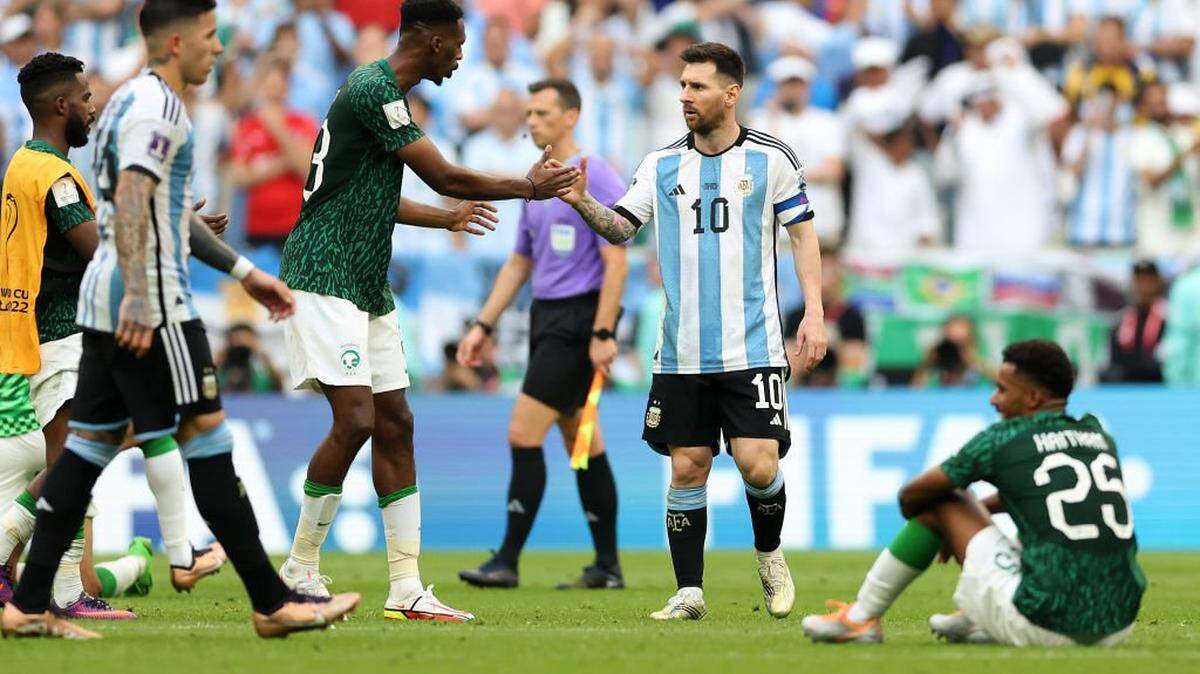
Saudi Arabia 2-1 Argentina, 2022
In the end, this result in Qatar did not matter. Argentina reformatted its side, scraped its way into the knockout stage and then subsequently relied on Emiliano Martinez’s saves, Lionel Messi’s brilliance and two penalty shootout wins to record its third World Cup triumph. But its tournament started with an entirely unexpected defeat by Saudi Arabia.
In the first tournament played in the Middle East, the sides from the Gulf States were able to count on fervent support. And while Qatar’s credentials as a major soccer nation were questionable, Saudi Arabia had a relatively proud history at the tournament. This was the team’s sixth appearance, and it had qualified for the knockout stage in 1994.
Things started as you would expect. Argentina was on a 36-game unbeaten run, and that seemed likely to continue when Messi rolled home a penalty.
But Saudi Arabia responded, using a high defensive line to squeeze the play, and enforcing a spell of serious pressure. Saleh Al Shehri scored a fine equalizer with a good low finish into the corner after halftime. Five minutes later, Saudi star Salem Al-Dawsari brought down a high ball, battled past a couple of challenges and then unleashed a shot that Martinez got a touch on but could not keep out.
Argentina went looking for an equalizer, but when Saudi Arabia’s high line was breached, it showcased some brilliant last-ditch defending, with one Hassan Al Tambakti tackle on Messi particularly impressive.
Saudi Arabia lost its next two matches and made the short trip home, while Argentina won the tournament, yet this result was, aside from the final itself, probably the most memorable game from the Qatar tournament.
This article originally appeared in The New York Times.
Copyright 2026 The New York Times Company