
How to make ambitious climate goals a reality? ‘Upend the status quo,’ student activist says
In 2018, officials at the cities of Olympia, Lacey, Tumwater and at Thurston County signed on to the goal of reducing greenhouse gas emissions 45 percent below 2015 levels by 2030 and 85 percent by 2050.
This summer, Olympia raised the bar, saying it wanted net-zero emissions by 2040.
Just how will it do that? To be determined.
Work is underway on a regional climate mitigation plan, a draft of which is expected in early 2020, that will identify specific regulations, incentives, policies or projects local governments should pursue and how far each action would go toward reducing emissions.
Olympia officials say they are waiting on that plan to identify key strategies to get the city to carbon neutral.
“Both goals are really ambitious,” said Allison Osterberg, senior planner at Thurston Regional Planning Council, which is leading the process. “What people really want to know is, we have this target, what will it take for us to achieve it?”
Until now, local governments have not had a “coherent, clear, concerted” plan to reduce emissions, said Tom Crawford, chairman of the non-profit Thurston Climate Action Team, or TCAT, who is among the volunteers advising on the mitigation plan.
So while the region’s population has grown, so too has its carbon footprint. From 2010 to 2017, while per capita emissions stayed the same, total emissions went up 9 percent as the region added nearly 25,000 people, according to a draft of TCAT’s 2017 emissions audit, the most recent year for which data is available.
To achieve the 85 percent reduction goal, the region will have to reduce emissions by about 6 percent every year from 2018 to 2050, according to TCAT. But in 2017, emissions were up about 6 percent from the previous year.
More than half of all emissions stemmed from heating and powering buildings, according to the 2017 audit. One reason for that is where we get our electricity: Nearly 60 percent of Puget Sound Energy’s energy that year came from coal and natural gas, according to the utility.
“The combination of those two is not great for our carbon footprint,” said Crawford, noting that could change soon with the passage of legislation this spring committing Washington to an emissions-free electricity supply by 2045.
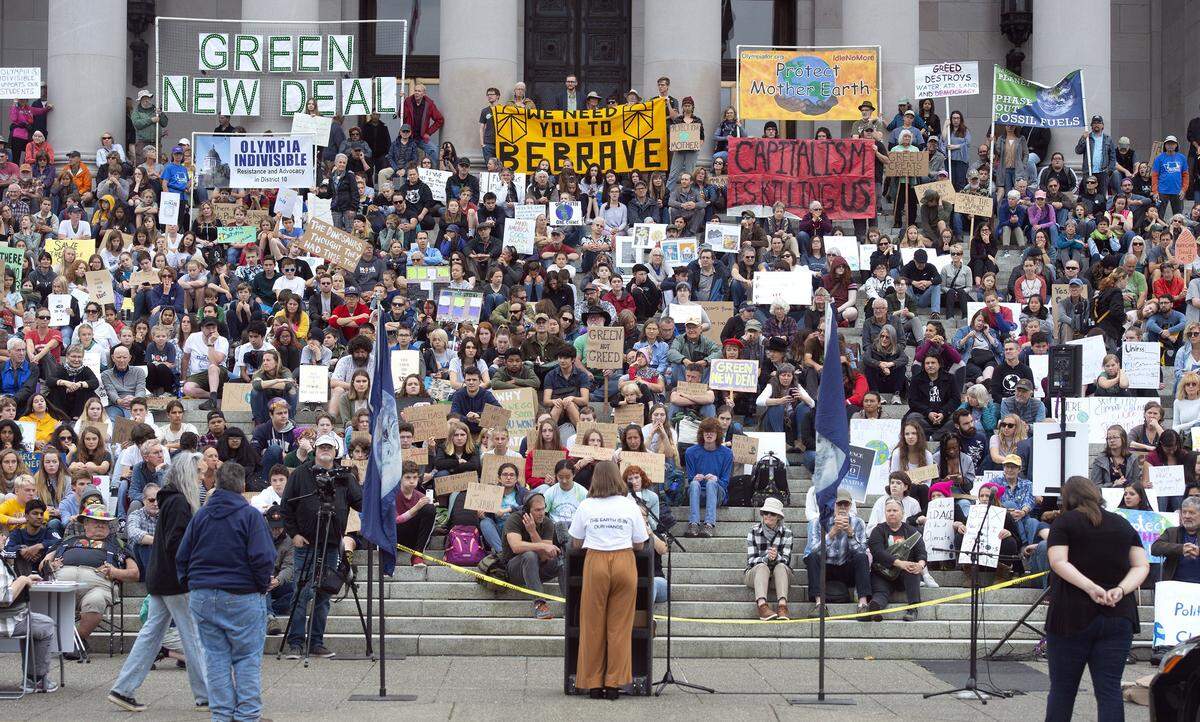
Olympia’s new goal came at the urging of student activists from Olympia High School’s Climate Action Club. In July, the City Council unanimously passed a resolution committing the city to working with young people to achieve net-zero emissions.
Louisa Sevier is a junior at Olympia High and a leader in the club. She said students wanted to see more urgency reflected in the city’s climate goal, citing a recent report from a United Nations panel warning the world has just about a decade left to act in order to avoid irreversible damage due to climate change.
She wants a local ban on natural gas in new construction — similar measures passed in Berkeley, California and were proposed in Seattle this summer — and a ban on single-use plastic products.
“What we know we need, and therefore what we want to do, is upend the status quo as far as our dependency as a society on fossil fuels,” she said. “It requires a different perspective that I don’t think a lot of people are able to grasp still.”
This story was originally published October 19, 2019 at 7:00 AM.
