
City Council weighs West Bay Yards development agreement after public hearing Tuesday
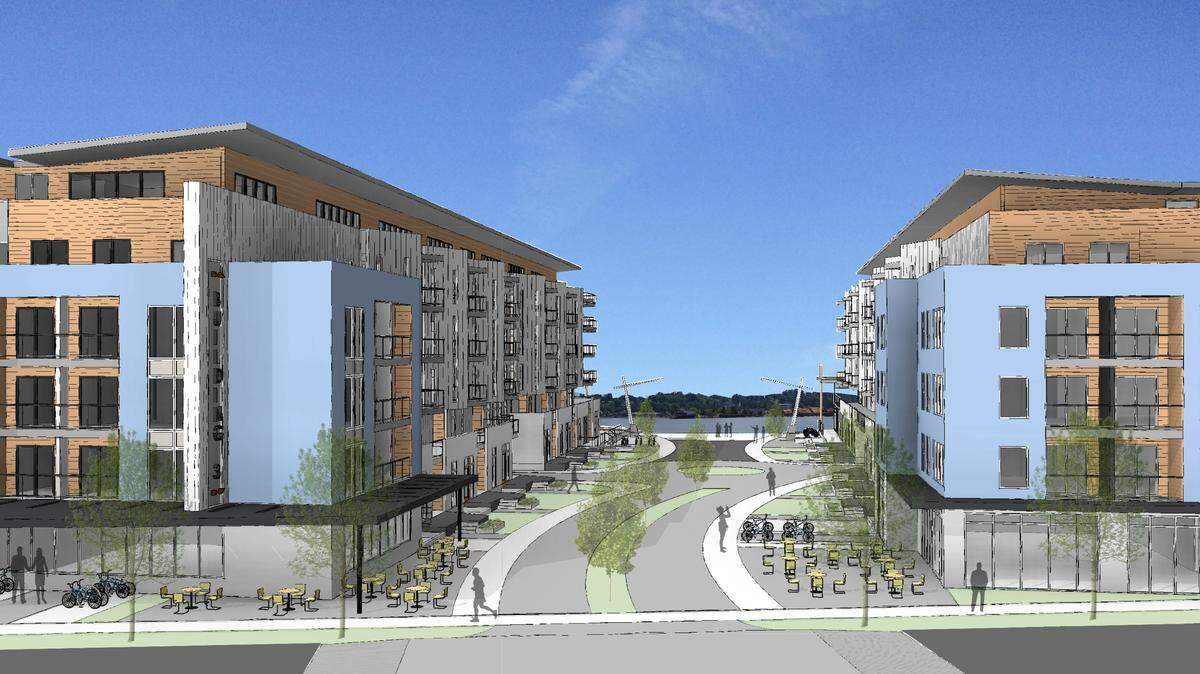
The proposed West Bay Yards development has not yet submitted an official application to the city, but it already has provoked a lot of interest among Olympia residents, who have submitted hundreds of pages of written comments hosted on a dedicated project page on the city’s website.
More than 20 people spoke at a public hearing on Tuesday night about the merits of the largest downtown housing development Olympia has seen in decades. West Bay Yards would construct 478 units of market-rate housing spread across five buildings, along with 20,000 square feet of commercial space, on the site of the former Hardel Mutual Plywood.
Built in the 1950s, the lumber mill was destroyed in a fire in 1996 and has been vacant since. Just south of the site is another vacant building that was previously home to Reliable Steel and was damaged by fire in 2010.
Last week, Hardel sold its property to The Milestone Companies, a Puyallup-based developer that has built projects in Olympia, Tumwater, and Spanaway, and is planning one in Lacey. Milestone first met with the city of Olympia last May, and is operating under the name West Bay Development Group LLC.
The Olympia City Council will vote next week on a development agreement for the project, which is a voluntary contract between a jurisdiction and a property owner. Development agreements are optional for a project to be built, but once agreed upon, they are binding. Developers of long-term, multi-phase projects sometimes seek them because they provide assurance that projects won’t run into issues related to changing regulations after they’ve already begun building.
Under the terms of the West Bay Yards development agreement, the city would agree not to change any of its existing land use regulations — things such as the zoning code, comprehensive plan, shoreline master plan, density, design standards — that would affect West Bay Yards specifically for the next 15 years.
It also locks in — or “vests” — development impact fees to their current levels for the duration of each phase. So if the city did increase impact fees, which it often does from year to year, the developer would continue to pay the 2021 fees until the next phase of the development, which is planned in three phases.
In turn, the developer agrees to make certain improvements to the property. In this case, the biggest one would be a commitment to restoring the West Bay shoreline in the terms laid out in the city’s 2016 West Bay Environmental Restoration Final Report. The terms include in-water restoration of intertidal beach and marsh areas, as well as a publicly accessible boardwalk/waterfront trail.
According to Ron Thomas of Thomas Architecture Studios, who presented renderings of the shoreline plans to the council, the work would cost millions of dollars, but he did not say specifically how much. Troy Nichols, a representative from West Bay Development Group LLC, previously told The Olympian that the site improvements would cost as much as $15 million.
Other work by the developer would include installing utilities (water, sewer, stormwater, and solid waste), and “frontage improvements,” including building new roads within the site.
In 2007, Hardel was ordered to do some environmental cleanup by the Department of Ecology. The developer will be required to comply with any additional cleanup that the state agency requires, according to a presentation by Tim Smith, a city planning and engineering manager.
In 2003, the area was rezoned from industrial to Urban Waterfront, a designation that includes high-density residential and commercial uses.
Residents weigh in
Doug Mah, a former Olympia mayor who now runs a political consulting business, was on city council at the time of the rezone and remembers hoping that a redevelopment proposal like this one would emerge.
“This is exactly the kind of project that was envisioned almost 20 years ago,” Mah said, praising the combination of dense housing and shoreline restoration. “The development agreement recognizes how difficult a project like this has been and will be and enables this vision that has been supported by nearly every elected city council member since 2001.”
Supporters of the development agreement pointed to the developer’s pledge to invest millions in restoring the shoreline and a public promenade, work that the city has identified as a goal but not undertaken.
“The fact that it’s going to be done with private dollars and we’re not spending taxpayer dollars, I just think it’s a marvelous win for the whole community,” said Elizabeth Bretschneider, a west side resident of 25 years.
Development agreements have been somewhat rare in Olympia.
According to Smith, the Merritt Manor and 2828 Martin Way projects both utilized them. Unlike those projects, which were both affordable housing for low-income people and those experiencing homelessness, West Bay Yards will be entirely market-rate apartments.
At the public hearing, several people focused their comments on the lack of affordable housing. In cities such as Seattle, a development like West Bay Yards would be required to reserve a certain percentage of units for low-income households, or pay into an affordable housing trust fund, a policy known as an affordable housing impact fee or “linkage fee.”
Council member Yến Huỳnh asked Thomas multiple times if affordable housing had been considered for the site, while Mayor Cheryl Selby asked if the developer would consider shifting some of the units to condominiums, to provide homeownership opportunities. The answer to both questions was no; Thomas said the developer was not interested in condos.
At the public hearing on Tuesday, many people commented that an environment impact statement (EIS) should be done now, before granting a development agreement.
“Deferring implementation of an EIS until some future unspecified time not only runs counter to SEPA regulations but also greatly increases the threat that any future revelations of environmental risks will be disregarded if the development plans have already reached an advanced stage of implementation,” said Barry Troutman, a retired Fish and Wildlife biologist.
The city granted the development agreement a “non-project” determination of nonsignificance under the State Environmental Policy Act (SEPA), which means that the developer can wait to do an EIS until after the development agreement is approved; that decision was appealed by Olympia Coalition for Ecosystems Preservation (Oly Ecosystems) but upheld by the city’s Hearings Examiner in February.
Daniel Einstein, president of Oly Ecosystems, said at the hearing that his group had already committed $4 million to restoring the West Bay long before this developer showed up. Einstein previously said that the group has offered to buy the property from Hardel at fair market value.
Others who opposed the development agreement said the project was simply too big, or would create more traffic. According to Smith, the developer will be required to do a “transportation impact analysis.”
Council is scheduled to vote on the development agreement on March 30, which is the last chance they get to weigh in on the project.
If the development agreement is approved, the next step is for the developer to apply for a shoreline permit, which gets decided by the Hearings Examiner. From there, the decision can be appealed to the state Shoreline Hearings Board*, and then to Thurston County Superior Court, which OlyEcosystems has already promised to do.
“There is not an action that would come back to the City Council after the development agreement,” Smith said.
Council members mostly asked questions on Tuesday, but one, Clark Gilman, already wrote on Facebook that he intends to vote against the development agreement. At the Tuesday hearing, Gilman questioned why a development agreement needs to be decided on before the city has a formal application, especially since it’s the city’s final word on the project.
“I just think that having the project application, the regulatory agency reviews, and the public hearings in mind when this comes to us would make a lot more sense,” Gilman said.
Olympia’s city code requires that any development agreement must be considered by city council prior to any actual project application being submitted. That sequence of events, according to an otherwise supportive letter submitted from the West Bay Drive Neighborhood Association, “has created a tremendous amount of confusion for the public about the process and the ability to comment on the actual application with regards to many important aspects.”
*Correction: This article previously said that the Hearings Examiner’s decision to grant a shoreline permit could be appealed directly to the Thurston County Superior Court. Before that, it can be appealed to the state Shoreline Hearings Board.
This story was originally published March 24, 2021 at 11:12 AM.
.jpg)