Lacey police chief finalists were asked about use of force. Here’s what they had to say
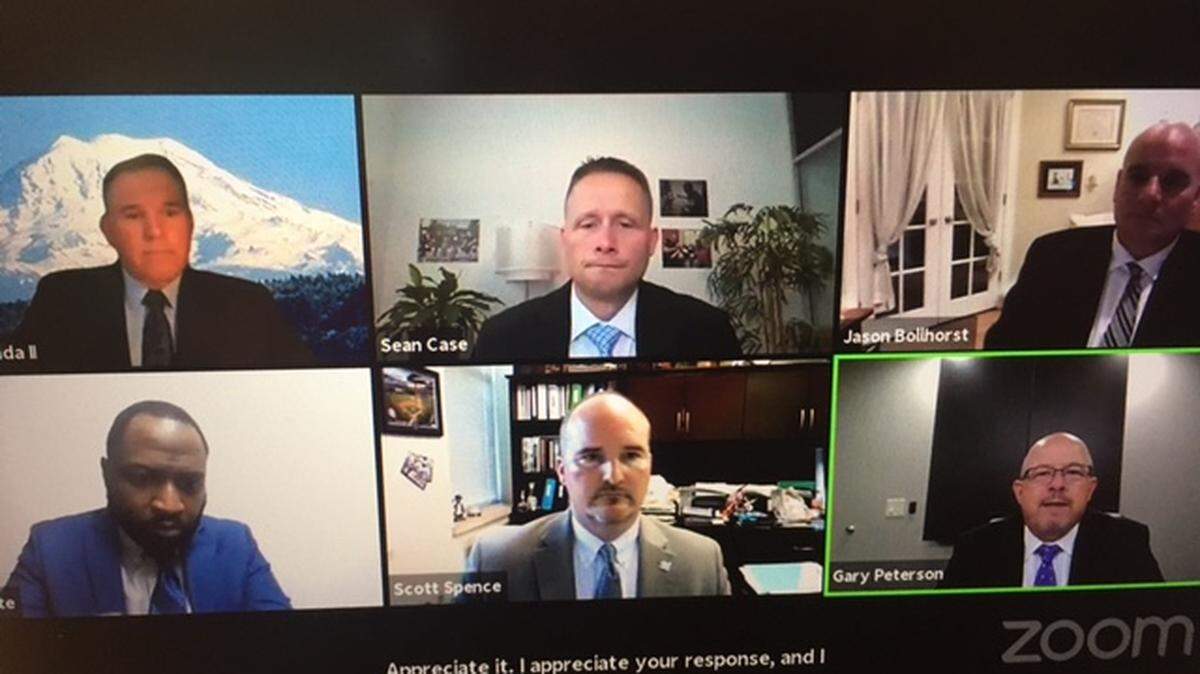
The four finalists to be the next Lacey police chief, including current interim chief Robert Almada, weighed in on excessive use of force when they appeared together in an online community forum last week.
The successful applicant will replace former Chief Ken Semko, who retired in April 2020. Almada has been serving as interim chief.
The three other finalists are Jason Bollhorst, a police captain with the Newport News Police Department in Virginia; Sean Case, a police captain with the Anchorage Police Department in Alaska; and John Pate, city manager and director of public safety in Opa-locka, Florida. Pate was previously a police inspector with the Cook County Sheriff’s Department in Chicago, according to his LinkedIn page.
Case was a finalist to be the next Olympia police chief before the search was put on hold. Information identifying the four finalists was not shared with the public prior to their public appearance.
In addition to the finalists, Lacey City Manager Scott Spence also took part in the forum, as well as Gary Peterson, founder, president and chief executive of Public Sector Search & Consulting, a California business that specializes in police chief recruitment.
Peterson acted as moderator for the nearly two-hour meeting. The finalists were asked a series of questions, but the final question was designed to gauge the candidates thoughts about excessive use of force.
Peterson asked: “Excessive use of force by police officers is a national and local concern that disproportionately affects vulnerable populations, including those in crisis and people of color. How would you address this issue?”
Bollhorst
“Having strong use-of-force policies begins with proper training and accountability for your standards and what’s expected. It all comes down to what the officers are doing and have they been held accountable throughout their careers.
“Looking at George Floyd’s case, there was a history of perceived issues (with the officer) that didn’t develop overnight, and supervisors along the path were fully aware of those issues, and nobody did anything about it. So, we need to hold our personnel accountable for issues that are outside the scope of our expectations.
“We only use force that is reasonably necessary to effect the arrest or protect somebody else from injury or harm. If we have an officer that sees something going wrong, it’s OK to step in, even if it’s a junior officer stepping in on a supervisor. It’s got to happen.”
Case
“What this really comes down to is that this is a chief problem. When you have an officer who uses force above simple hand-cuffing or escorting someone from one position to another, that force has to be documented. If that force rises to a strike, use of a tool, injury or complaint, or more significant use of force, it has to be reviewed by a supervisor in the chain of command. There’s just no two ways about it. It has to be looked at and command staff have to be properly trained to look at that use of force.
“If we knew use of force happened, why didn’t we do something about it? Ultimately that rests with the chief of police. We have to have good and adequate investigations, and once we get to the conclusion of the investigation, we have to take the appropriate discipline and corrective action.”
Pate
“The first issue at hand is really looking at implicit bias within your law enforcement agency and ensuring that your officers know what their implicit bias is with the Black and Brown population, and individuals in crisis, and really drill down so they understand what their implicit bias is toward those groups of individuals and become cognizant of their thought process and interaction with those individuals. Developing policies and procedures that speak to the sanctity of life, trying to prevent those we interact with from losing their life.
“What is the responsibility of our supervisors that supervise their officers? For a long time I investigated law enforcement. We saw officers being held accountable but not their supervisors. Supervisors have a responsibility to report that use of force action.”
Almada
“I think it starts with understanding that it’s not us versus them, it’s a we. We are part of the community, we are not an occupying force. We start with that mindset. And then we have strong policies that are clear and understandable and can be applied in a clear way. We also have scenario-based training, crisis intervention and de-escalation training.
“It’s also really important that people understand that we have a duty to intervene at all levels. For example, I know an officer who worked as a temporary community service officer before the officer went to the academy. This CSO was paired with another community service officer who was watching a prisoner at an area hospital. The newer community service officer wasn’t talking to the prisoner as well as we would have liked, so the CSO took that person aside and said, ‘That’s not how we talk to people here, that’s not the Lacey way. We treat people here with respect.’”
City Manager Spence said the city plans to narrow the finalists, then make a conditional offer and complete a background check before making a final offer to the next chief.
This story was originally published June 19, 2021 at 5:45 AM.