Can a county commissioner date an employee? Here’s what the law, internal policies say

READ MORE
Commissioner Clouse investigation and fallout
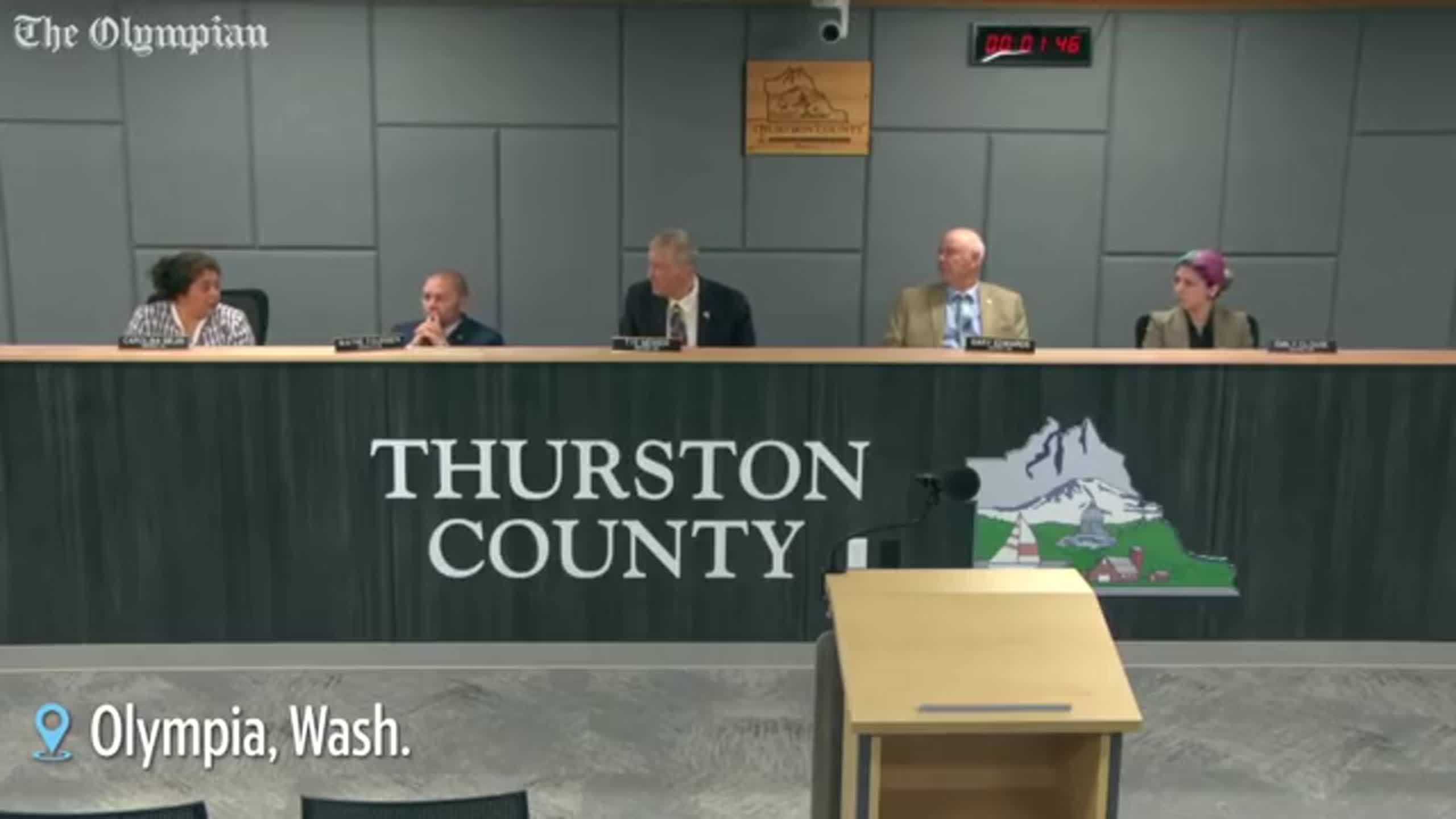
Thurston County’s commission removed Emily Clouse from her appointed advisory boards and commissions on Aug. 13, 2024, after receiving a sexual harassment complaint from her executive aide.
Expand All
Over two months after Thurston County Commissioner Emily Clouse was suspended from some of her duties by her seatmates, questions remain about her alleged conduct and the legal trouble the county may be facing.
The commission voted to suspend Clouse from her appointed boards and commissions on Aug. 13 and promised in a Sept. 6 letter to release a final report on the investigation. The investigation reportedly concerns a workplace-dating relationship between Clouse and a county employee.
So far, the county has declined to say when the final report may be released, leaving the public to piece together details from statements by commissioners and Clouse’s attorney as well as reported information leaks.
In the meantime, The Olympian has reviewed the county’s personnel rules and spoken with two area attorneys to get an idea of how a workplace-dating relationship may lead to legal liability for employers.
What does the law say about workplace dating?
State and federal law don’t directly address dating between two consenting employees, but it does prohibit sexual harassment, which is unwelcome conduct of a sexual nature, according to the Washington State Office of the Attorney General. As such, employers may be liable for this behavior between employees if they do not act to address it.
Julie Anne Oberbillig, an Olympia-based employment attorney, said state and federal law recognizes that there is a power imbalance between managers and employees.
“If the harassment is done by a manager, or an owner of a business or an executive, somebody in a high-level position, then the employer will always be liable for harassment because it is presumed to interfere with that person’s ability to carry out their job,” Oberbillig said.
Oberbillig, who primarily works as a plaintiff attorney, spoke generally about how workplace relationships can lead to legal liability for an employer. She is not involved in Clouse’s situation and declined to comment directly on it.
She said there are two types of sexual harassment that are legally recognized under Washington State Law Against Discrimination (RCW 49.60): hostile work environment and quid pro quo.
The Office of the Attorney General defines a hostile work environment as harassment that is “frequent or severe enough” to interfere with a person’s ability to perform their job.
Such behavior may include unwelcome, sexually suggestive comments or jokes, unwelcome and repeated requests for dates, offensive gestures, inappropriate touching or displaying pornographic materials.
Quid pro quo, on the other hand, happens when a “supervisor or manager asks for sexual favors from an employee in return for employment benefits,” according to the Office of the Attorney General.
“Benefits” may include a promotion, salary increase, career development opportunities, special projects and more.
Stephanie Stocker, an Olympia-based attorney, said lawyers may also sue for “wrongful termination in violation of public policy” and “constructive discharge. ” These claims are known as “Common Law Tort” under state law. She explained both of those claims were created out of case law rather than codified under a state statue (RCW) or Washington Administrative Code (WAC).
She said “wrongful termination in violation of public policy” can occur when an employer fires someone for making a complaint that is of interest to public policy. An example of a matter that may be of interest to public policy is the misuse of public funds or illegal conduct.
“Constructive discharge” occurs when an employer makes working conditions so bad for an employee that it pushes them to quit. This is usually done to get rid of someone without firing them, she said.
“If they’re like, ‘Oh, we didn’t fire her though,’ it doesn’t matter.” Stocker said. “My client resigned because you made her life a living hell and now that counts as if you terminated her.”
Stocker started her career defending companies against such claims, but she now primarily works as a plaintiff attorney.
Notably, Stocker represented a client who settled with Lewis County over the conduct of Superior Court Judge Nelson Hunt. She is not involved in Commissioner Clouse’s situation at Thurston County.
How may the law apply to Thurston County’s situation?
The law around sexual harassment may be relevant to the situation at the county if leaked allegations prove true.
Last month, The Chronicle reported it obtained a Sept. 5 letter from an attorney representing a county employee who made a complaint against Clouse. The Olympian has made a public records request for that letter, but it has not been provided.
The letter reportedly accused Clouse of engaging in a “pattern of abusive, unwelcome and sexual behavior” toward an employee and firing him about 30 minutes after he reported the alleged conduct to the county’s human resources department on July 26.
Notably, the attorney accused Clouse of creating both a “hostile work environment” and conduct that “qualifies as quid pro quo sexual harassment,” according to The Chronicle.
Mia Robbins, Clouse’s attorney, previously denied the allegations in the leaked letter and said it was “simply leveraging untruthful allegations to capitalize on Thurston County taxpayers.”
Speaking generally, Oberbillig said a hostile work environment can develop for many reasons. For example, she said people may misinterpret behavior, seek to dominate someone else or be ignorant about the law.
Some people may start flirting, but then one of them may change their mind while the other does not and continues to push, she said.
Oberbillig also said a hostile work environment may develop between a manager and employee if, for example, a manager pressures the employee into a relationship with unwelcome advances.
Quid pro quo sexual harassment may occur in a manager and employee relationship if, for example, the manager demands the employee enter into a dating relationship in exchange for employment benefits, Oberbillig said.
There also may be “negative” quid pro quo, Oberbillig said. For example, she said a manager may threaten to fire an employee if the employee tries to end the relationship. If a manager fires an employee for ending a relationship, she said that constitutes retaliation.
Oberbillig said she sees hostile work environment cases more often. She believes it’s because most people realize that asking for sexual favors is a problem. However, she said quid pro quo sexual harassment still happens.
“One of the reasons that it’s difficult is because you spend so much time at work,” Oberbillig said. “For most people, it’s your primary activity during the day, other than being at home… so you’re kind of captive.”
The Thurston County Commission heard a preliminary verbal report of a third-party investigation into Clouse in a closed-door Aug. 29 meeting, The Olympian previously reported.
On Sept. 3, Commissioner Tye Menser made a failed motion to reinstate Clouse and said the “inflammatory allegations” that justified her suspension were found to be unsubstantiated by the investigator.
Based on her own experience, Stocker said she does not let “independent” investigations, even by government authorities, deter her from pursuing damages for a client.
“I don’t put a lot of faith into third-party investigations of things,” Stocker said. “Nine times out of 10, they don’t find anything wrong. … I’ve settled every single one of my cases since I started my practice and half of them, they’re like ‘oh, we don’t find discrimination.’”
How is a sexual harassment complaint escalated?
An employer is legally required to look into a sexual harassment complaint and put a stop to the harassment if it is happening, Oberbillig said.
Remedies may include additional training, demotion, reassignments, relocations and even termination, she said.
Oberbillig recommends people contact an attorney if they feel like that process is “going awry” for them. For example, she said an employer may incorrectly find that nothing wrong happened and people should go back to work.
An employer also may retaliate against the complainant by firing them, demoting them, transferring them to a difficult shift or any number of adverse actions, Oberbillig said.
Stocker said a lawyer may act on the complainant’s behalf and send the employer a “demand letter.”
Such a letter would list the facts of the matter, cite the relevant law, and detail the damages and losses, she said. It essentially challenges the employer to settle with the complainant or risk a lawsuit, she said.
Stocker said she would direct any claims at the employer because she does not have standing to sue a specific manager under employment law.
“I really focus on the employment area because it allows carte blanche of the damages,” Stocker said. “So it bodes better for my client if we go the employer route.”
In the case of the county, there’s another process that must take place before a matter may reach the courts: the complainant must file a tort claim.
“If you worked for a government entity, city, county, state, etc., you have to submit a tort claim before you can sue in court because it gives the entity an opportunity to decide if they want to settle or negotiate those claims short of litigation,” Oberbillig said.
Stocker said she would file a demand letter after a tort claim has been filed. Sixty days after filing the tort claim, she would have standing to file a lawsuit.
If a matter does go to court, Oberbillig said the employee has to bring sufficient evidence to show that the harassment likely occurred.
From there, Oberbillig said the employer has to provide a legitimate, non-discriminatory reason for their actions.
“The general rule is that employers have a lot of leeway in letting people go,” Oberbillig said. “They just can’t do it for any illegal reason.”
Lasty, she said the employee has to prove that the employer’s reasoning is pretextual, meaning it’s not true. From there, the court may award damages, she said, but not reinstatement.
“If reinstatement happens, it’ll happen through exceptional means, such as private settlement or arbitration,” Oberbillig said.
A lawsuit can be filed in state or federal court. However, Stocker said she prefers to file a lawsuit in Washington state courts because state employment law is more progressive than federal law.
“I don’t file in federal court,” Stocker said. “Washington laws are way more robust and protective of employees.”
Additionally, Stocker said she always requests a jury trial rather than a bench trial for her clients given the complexity of these types of cases.
“We never do bench trials because so much of these cases are based on circumstantial evidence,” Stocker said. “At the end of the day, does the jury like my client? Do they trust my client?”
Stocker and Oberbillig said state law also requires the employer to pay the complainant’s attorney fees if the complainant wins in court. That can be a significant bargaining chip in negotiations.
The parties can settle at any time from the moment a tort claim is filed or a demand letter is sent, Stocker said. Such settlements can be reached privately or through a mediator, she added.
What do county policies say about work-place relationships and harassment?
High-ranking officials and employees alike are expected to follow the county’s Personnel Rules and Policies, an 84-page document that details everything from mundane expectations to procedures for reporting discrimination and retaliation.
The document does not explicitly prohibit workplace dating relationships or stipulate that a workplace dating relationship must be reported to the Human Resources department. When asked to elaborate on the county’s notification policies, HR director Maria Aponte confirmed notification was not required.
The county’s policies do prohibit the employment of an employee’s, board or commission member’s or officer’s “immediate family” in the same office or department. The policy document’s definition of immediate family includes a domestic partner with an affidavit, which requires the partners to be in a relationship for at least six months and share a residence, among other requirements.
There is no definition for a less formal intimate relationship, such as a brief dating relationship, in the document. The Olympian asked Aponte if people who are dating are allowed to work in the same office or department. Aponte only said this “would be case dependent.”
The Personnel Rules and Policies document does prohibit the alleged actions described in the Sept. 5 letter the attorney reportedly sent to the county about Clouse. Those expectations apply to all people who work or volunteer for the county.
“All Thurston County elected officials, directors, managers, supervisors, employees and volunteers are responsible for complying with this policy to maintain a workplace free from any form of discrimination, harassment or retaliation, including setting an example of proper behavior and reporting discriminatory behavior that they observe,” Policy Number 16.1 states.
Any employee or volunteer who feels discriminated against may file a written report with the county’s Human Resources department or alternatively with the Chief Civil Deputy Prosecuting Attorney, under the policy.
That report should prompt an investigation. Chapter 14 of the document indicates investigations should be conducted as “confidentially as possible.”
That means the identity of the reporting employee is kept confidential to the extent permitted by law for the duration of the investigation. The reporting employee’s identity may be disclosed if the employee later consents to it in writing, according to the policy.
Aponte said state law exempts investigative records from being disclosed in response to a public records request while the investigation is active.
Those records may be disclosed after the complaining employee is informed of the investigation outcome, but the names of the complainants, other accusers and witnesses will be redacted unless those people consent to disclosure, according to state law.
The county has many “at-will” positions, including the assistant county managers, department directors, commissioner executive aides and more, according to the county’s at-will salary chart.
An “at-will” employee can be fired at any time for any reason or no reason at all, according to the at-will pay plan.
“Positions covered under this plan are ‘at will’ and serve at the pleasure of elected officials, a department director or the County Manager,” the plan reads.
The county’s Personnel Rules and Policies do not state whether a county commissioner must involve HR in a termination decision. Oberbillig said state law does not require HR to be involved in a termination decision.
When reached for comment, Aponte said the “practice at the County is that elected officials consult with Human Resources prior to taking employment actions.”
This story was originally published October 28, 2024 at 5:00 AM.