Appeal of controversial energy storage facility goes to Thurston Co. commissioners
AI-generated summary reviewed by our newsroom.
- Residents Brian and Tamara Haight appealed the examiner's reversed approval on March 19.
- Convergent proposed a 5.4-megawatt battery energy storage system at a Rochester site.
- Commissioners recessed to a >2-hour executive session and made no decision by 5:10 p.m.
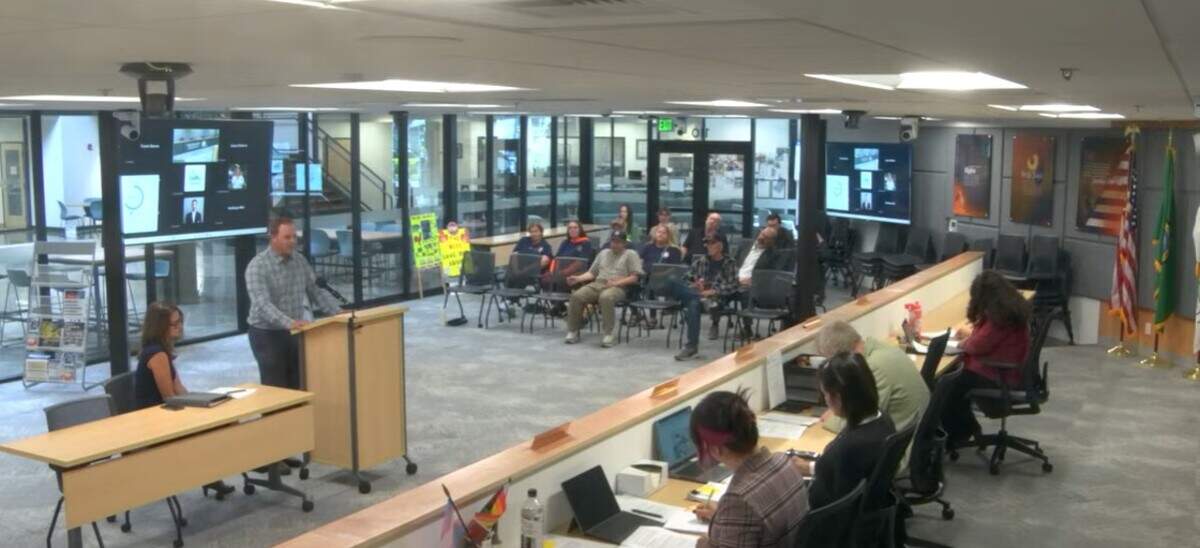
Residents unhappy about a proposed battery energy storage system, or BESS, in south Thurston County, brought those concerns on appeal before the county commissioners on Wednesday.
The BESS proposal, which was pitched by a New York company called Convergent Energy and Power, has been on quite the journey.
Late last year the county hearings examiner rejected a special use permit tied to the proposal, then Convergent was granted a motion for reconsideration. After that hearing, the examiner reversed herself and approved the permit, which resulted in Wednesday’s appeal before the board.
It was appealed on March 19 by residents Brian and Tamara Haight, according to county information. Both appeared at Wednesday’s hearing.
Convergent wants the permit to construct a 5.4-megawatt battery energy storage system at 7505 183rd Ave. SW in Rochester. Such systems are used to store and supply additional power to the grid. Convergent would own the system, but would lease it to Puget Sound Energy, according to comments made at the meeting. PSE operates a substation near the proposed site.
Some arguments at the hearing
Appellant Brian Haight was the first to address the commission. His arguments touched on zoning, safety, lack of detail and a flawed process.
“The comprehensive plan clearly states that (land zoned) rural commercial center must be dependent on a rural setting, and that the (proposed) use is not dependent on a rural location if it serves a larger than rural market,” he said. “Serving the entire (power) grid is far larger than a rural market, and so this use should be denied.”
West Thurston Fire Chief Nathan Drake, who has testified at previous hearings, has also been opposed to the proposal. He cites the risk of fires at such facilities.
“There is ample evidence in the record that the proposed use could result in substantial adverse effects on the adjacent properties and to the public health, safety, and welfare,” Haight said.
And he wanted to know why more information about alternative sites wasn’t presented, he said.
“No full accounting was ever given to demonstrate why this particular site was needed, and is not merely more convenient or more profitable for the applicants,” he said. “No alternative properties were presented in order to determine if they presented less adverse effects and burdens to the community.”
He added that the applicant and the examiner have stated that the project will not be built if a fire marshal does not approve of the emergency response plan in the event of a fire or other hazards.
Haight argued that happens after it’s built.
“The time of a fire marshal review is prior to commissioning and energization,” he said. “The project’s already been constructed at that point; the hazards are already present.”
Attorney Reuben Schutz addressed the commission on behalf of Convergent.
“Our position obviously is that the hearings examiner’s decision should be upheld, and that’s because it is based on a substantial record,” he said. “We’re talking about multiple technical reports on groundwater, on traffic, on noise, on geology, fire risk, etc. You know, county staff reviewed in detail and recommended approval. That’s the health department, that’s the fire marshal, etc.”
He also defended the process to select the Rochester site.
“There’s a need by Puget Sound Energy, and then they looked at 150-plus sites,” he said. “First, they’re looking at the zoning, they’re looking at the size, they’re looking at the location, the necessary facilities, availability, critical areas, and throughout that process – and this is all in the record – they narrowed it down to five locations, and then based on several criteria, including the fact that there’s a substation directly across the street, which is important to PSE, they chose this location.
“This was a long process,” Schutz said. “It was an arduous process to determine this location. It wasn’t, you know, pointing a finger at a map.”
On rebuttal, Tamara Haight expressed disappointment in the hearings examiner.
“In the initial hearing, the examiner found the community testimony to be credible,” she said. “On reconsideration, however, she dismissed them as just reiterated. Not a single public comment exhibit testimony from the community members was cited in the findings or conclusions, and that evidence conflicted with the applicant’s information, so that was important for her to look at, and she did not.”
Commissioner questions
Commissioner Tye Menser asked a question of Schutz, pointing out that “the appellant made reference to Thurston County code about no undue burden on any services, and then we have evidence from the fire district that it would be an undue burden.”
“My question for you: was input from West Thurston Fire not credible to you?” Menser asked.
“The fire district said we don’t have the capacity, but there wasn’t any actual evidence cited, and the examiner found that we, the applicant, proposed impact fees, if necessary,” Schutz said. “The code allows for impact fees if they, if more (fire district) equipment is needed, then impact fees can be used.”
Commissioner Carolina Mejia also inquired about why there wasn’t more information about the alternative sites.
“You know, when you’re talking about 150 sites, are you supposed to have a dossier on each site, you know, with drawings and so forth?” Schutz said. “That wouldn’t make any sense. It would be overly burdensome, unduly burdensome, so county staff in their review are charged with, you know, making that determination.”
“... The neighbors want more, but you know what’s practical under the circumstances, what’s reasonable, that’s what should be applied, and you know ultimately staff and the hearings examiner are tasked with making that determination, and they did,” Schutz added.
The hearing, which lasted a little over an hour, was followed by an executive session of more than two hours. The commission finally emerged at 5:10 p.m. and made no decision. The Olympian reached out to Commissioner Emily Clouse after the meeting who said a decision is expected by Wednesday, May 27.
Possible outcomes: denial, approval or the commission sends it back to the hearings examiner for more review.
This story was originally published May 21, 2026 at 10:03 AM.