Lawsuit filed against WA state, several agencies for automatically deleting messages
Under Washington state law, emails and text messages qualify as public records. So do group chats and instant messages that now dominate communication in 21st-century workplaces.
A recently filed lawsuit contends that a state agency under the Governor’s Office may have broken that law by deleting messages aimed at hindering a McClatchy reporter’s efforts to obtain public records.
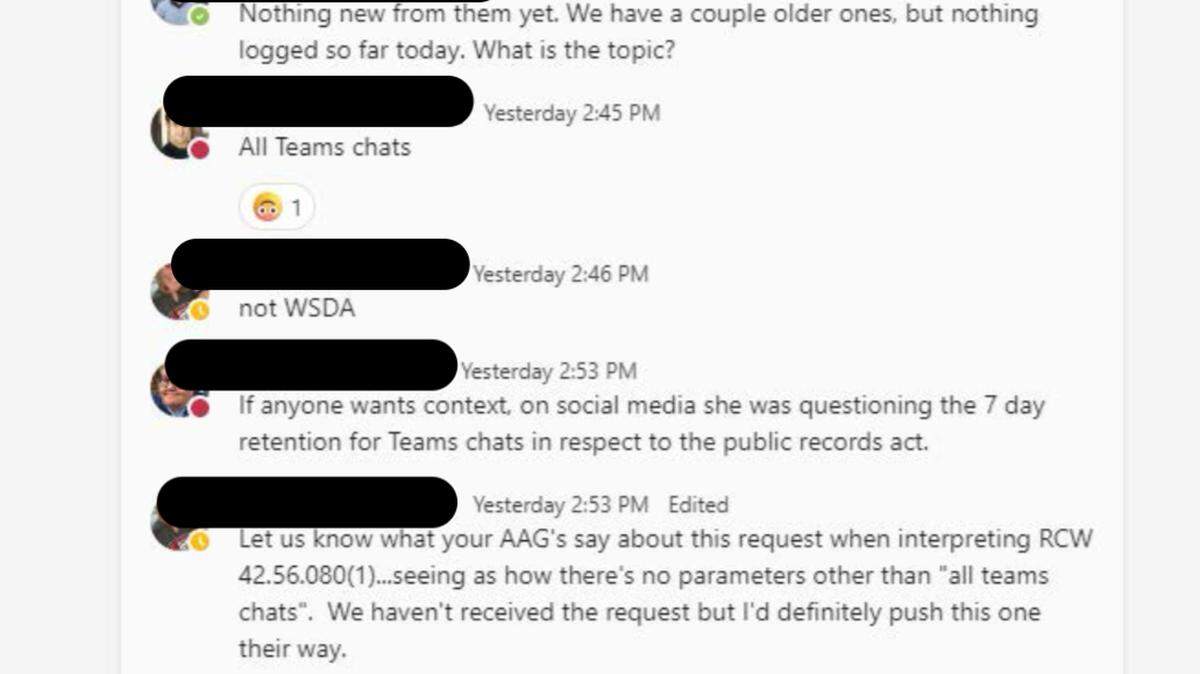
In October, McClatchy first reported that all agencies under the auspices of the Governor’s Office had switched in 2021 to a seven-day retention policy for messages exchanged on the Microsoft Teams platform. This means that any messages not intentionally saved by staff members are automatically permanently deleted after seven days.
A spokesperson for the governor told the news outlet at the time that all agencies are encouraged not to use the platform for work-related messages, and if employees do use Teams for “non-transitory communication,” it is to be preserved by individual staffers to abide by Washington’s Public Records Act.
One of the questions: If the communications are automatically permanently deleted, how will public records officials know if the messages contained substantive content that should have been preserved?
In August 2023, McClatchy filed requests to see if agencies were properly keeping work-related messages by requesting a week’s worth of Teams messages from various agencies under the governor’s office. Two agencies told the news outlet it would cost more than $500 for them to provide a week’s worth of Teams messages.
Records provided later to the news outlet from August showed that the reason for the high charges may be due to public records officer Pamela Potwin at the Department of Agriculture encouraging other governor’s agency records officials to charge the reporter for the documents, and comparing the reporter to a requester in Seattle who was considered a nuisance to officials due to their requests for public records.
“Remember we have a former frequent flyer [sic] requestor, known to harass the City of Seattle and the SPD in particular, for that addition and the ‘bot’ section to the PRA. If all else fails, get that payment invoice ready.”
Subsequent records requests showed that the message was later deleted by Potwin. When McClatchy questioned the agency about the message, Amber Betts, a public information officer said the comment was not malicious.
“It was simply meant to help agency staff struggling with a request for potentially a large volume of records,” Betts said.
In a Teams chat after the request for records was submitted to one agency, public records officials can be seen discussing how they should charge the reporter for the full amount instead of offering a 10% deposit to start the production of records.
“I don’t think they will pay, I just didn’t want us to have to review and produce that many records by February,” said one of the public records officials in the thread.
According to Washington state law, removing, altering, mutilating, destroying, concealing, or obliterating public records and documents is a class C felony, punishable by imprisonment and/or a fine up to $1,000.
“If an employee acts inappropriately or violates an agency policy, we expect agencies to take appropriate disciplinary action,” said Jaime Smith, executive director of communications for Gov. Jay Inslee’s Office. “And, of course, employees who violate a law should similarly be held accountable.”
Other concerns about Teams messages
The deletion of those records is one part of a larger lawsuit recently filed in Thurston County Superior Court against the state and several governor’s agencies by open government advocate Jamie Nixon over the seven-day retention policy for Teams messages.
The lawsuit seeks, among other things, a “determination that respondent’s automated destruction of public records from chat platforms violates retention standards for public records and state statute” and “a determination that respondent has been automatically destroying public records sought in response to his public records requests.”
The lawsuit also seeks judicial intervention to stop the automated destruction of records because it claims that “state officials like the Attorney General and Governor have failed to protect public records from automated destruction and have facilitated the destruction in violation of their duties.”
When asked if the governor was privy to conversations about the seven-day retention policy or if he was aware that potentially hundreds or thousands of non-transitory messages have been deleted weekly because of the policy, Smith told McClatchy that the governor “was not involved in the process.”
“He is aware that agencies faced limitations with the provider of the Teams platform. The governor expects all our agencies to comply with retention policies,” Smith said. “The Teams platform is intended for transitory messages only, and if an employee inadvertently uses it for non-transitory purposes they must retain the message.”
The seven-day retention policy appears to go against model rules laid out in a Washington Administrative Code that notes that “because different kinds of records must be retained for different periods of time, an agency is prohibited from automatically deleting all emails after a short period of time (such as 30 days).”
“Indiscriminate automatic deletion of all emails or other public records after a short period, no matter what their content, may prevent an agency from complying with its retention duties and could complicate performance of its duties under the Public Records Act,” according to the WAC.
The Attorney General’s Office crafted those rules in 2006 under former AG Rob McKenna, and won an award for it from the Washington Coalition for Open Government.
Brionna Aho, communications director for the AG’s Office, acknowledged that the agency crafted those rules but noted that “agencies are not required to adopt the model rules.”
Records also show there were concerns with the seven-day retention policy before it was implemented by WaTech, an agency known as “the consolidated technology services agency” for state agencies.
Internally there were also concerns at various agencies after McClatchy began to ask questions about the seven-day retention policy.
“It’s happened: A Public Disclosure Request for ALL CHATS throughout the agency” read one email subject line.
“The response consisted of more than 40,000 threads. All unredacted; no exemptions. It’s done,” the email said.
One agency shut down their Teams messages temporarily as they figured out a way to retain Teams messages for a longer period of time.
In an email to McClatchy, Washington Department of Corrections spokesperson Chris Wright confirmed that the agency stopped using Teams in late 2023 through earlier this year.
“As the result of litigation, DOC did suspend the use of Teams Chat for several months while transitioning from the seven-day retention period to the current 30 days,” Wright said. “DOC is committed to transparency and has worked to educate staff on the appropriate use of Teams Chat and limit its use to brief, transitory messages.”
While agencies now have the ability to determine their own retention schedules for Teams messages, it is unclear at this time how many are still using the seven-day retention policy.
Microsoft did not respond to specific Teams questions from McClatchy.
This story was originally published June 10, 2024 at 5:00 AM.