
A barrage of ballots: Get ready to vote — often — in 2020, Thurston County
If you’re a Thurston County voter, now is a good time to stock up on dark ink pens and check your voter registration: It’s a five-election year, and three of them fall in the first four months.
The votes start with school funding, include a first-of-its-kind presidential primary, and crescendo to a General Election finale in November that will decide several key state and local seats — along with the U.S. President.
Like in all Presidential Election years, Thurston County Auditor Mary Hall says her office is staffing up for the increased workload. The office also plans to push voter outreach and education.
Her number-one focus, though? Leading the charge to change a Washington law that lets the state shirk its share of election costs in even-numbered — read: traditionally much more expensive — years, leaving counties to foot the bill.
What’s on Thurston County’s 2020 ballots
February
In a Feb. 11 special election, every school district in Thurston County has one funding measure on the ballot and some will have two. Ballots for that election already have been mailed to military and overseas voters.
March
Before the results of that election are certified, the Auditor’s Office will mail ballots for the March 10 Presidential Primary Election that falls one week after Super Tuesday.
The March primary was moved up from May through a state law passed last year and marks the first time in state history that Washington state Democrats and Republicans will use only votes — not caucuses — to decide how they’ll allocate delegates.
It’s the only election for which Washington voters are required to mark and sign party declarations, according to the Secretary of State’s website. Voters will need to choose one candidate from the party they marked on their envelopes — there’s no option to vote as an independent.
The party a voter marks on their primary ballot won’t impact how they can vote in future elections, according to the Secretary of State.
Secretary of State Kim Wyman certified lists of party candidates Tuesday. This year, most of the action will take place within the Democratic party: The state Republican Party submitted Donald Trump as its sole candidate for consideration.
Democrats submitted a list of 13: Elizabeth Warren, Amy Klobuchar, Bernie Sanders, Andrew Yang, Pete Buttigieg, Tom Steyer, Tulsi Gabbard, Joseph R. Biden, Cory Booker, Michael Bennet, John Delaney, Deval Patrick, and Michael Bloomberg. Democratic voters will also be able to mark an “uncommitted” option — meaning they prefer delegates to the Democratic National Convention remain uncommitted and able to choose at a later date.
April
A few weeks after presidential primary results are official, an April 28 special election will ask Thurston County voters whether the county should raise property taxes to pay for a new courthouse.
County Commissioners have voted 2-1 twice — with Commissioner Gary Edwards voting no both times — to put the measure on the ballot. If voters approve, the proposition will authorize a property tax levy-lid lift that allows an increase of up to 47 cents per $1,000 of assessed value, starting in 2021 and lasting for 25 years. For the owner of a $300,000 home, that translates to about $141 more per year.
The money would be used to build a new courthouse complex to replace the 41-year-old complex on Lakeridge Drive Southwest. Officials say the current facilities aren’t functional, secure, or adequate to serve the county’s growing population, and that construction costs aren’t going to get cheaper if the county waits to build.
It’s yielded a divided response in public hearings.
Critics such as Commissioner Edwards have questioned the logic of a special election, which the Auditor estimates could cost the county about $177,000 or so out-of-pocket. Edwards has said he doesn’t think the county has “developed the public trust” needed to pass the issue.
Commissioner Tye Menser, on the other hand, has argued the proposal must go to the voters, given the resources that have been spent on preparing the plan.
Other measures could show up on April ballots, Hall said, which would split up the costs. The deadline for adding a measure is in late February.
August & November
Seats in the U.S. House of Representatives and the state Legislature, statewide elected positions, two County Commissioner seats, and other local positions will be up for a vote this fall.
The August primary vote will whittle down the candidates before voters make their final decisions Nov. 3, which will include the final vote for President of the United States.
2020, in summary
All told, here’s a timeline of important dates for Thurston County voters in 2020:
Jan. 22: February Special Election ballots mailed
Feb. 11: February Special Election
Feb. 19: Presidential Primary ballots mailed
Feb. 21: February Special Election results certified
March 10: Presidential Primary Election
March 20: Presidential Primary results certified by county
March 27: Presidential Primary results certified by Secretary of State
April 8: April Special Election ballots mailed
April 28: April Special Election
May 8: April Special Election results certified
May 11 through 15: Candidate filing week for positions on ballot of August primary/November election
July 15: August Primary ballots mailed
Aug. 4: August Primary Election
Aug. 18: August Primary Election results certified by county
Aug. 21: August Primary Election results certified by Secretary of State
Oct. 14: November General Election ballots mailed
Nov. 3: November General Election
Nov. 24: November General Election results certified by county
Dec. 3: November General Election results certified by Secretary of State
Voters can register in person at the Auditor’s Office in Building 1 of the courthouse complex on 2000 Lakeridge Drive SW in Olympia until 8 p.m. on Election Day, or online until eight days before an election.
Anyone can check voter-registration status online at votewa.gov.
How much running elections costs — and who pays
After an election, the county Auditor’s Office divvies the election’s total cost among the jurisdictions with issues on the ballot, using a formula that considers the number of registered voters in a given jurisdiction and how many issues that jurisdiction put up for a vote, Hall and Elections Manager Tillie Naputi-Pullar explained.
Local jurisdictions, such as school districts and cities, reimburse the county for their portions of the cost as determined by that formula, Auditor Hall said. In odd years, the state reimburses the county, too.
But in even years, such as 2020 and every year when statewide offices typically expire, the county foots the state’s bill via its General Fund, which pays for a wide array of county services.
In a presentation to county commissioners late last year, Robin Campbell, Thurston’s assistant county manager and budget director, showed that the county’s General Fund has been declining in recent years and is projected to continue to decline.
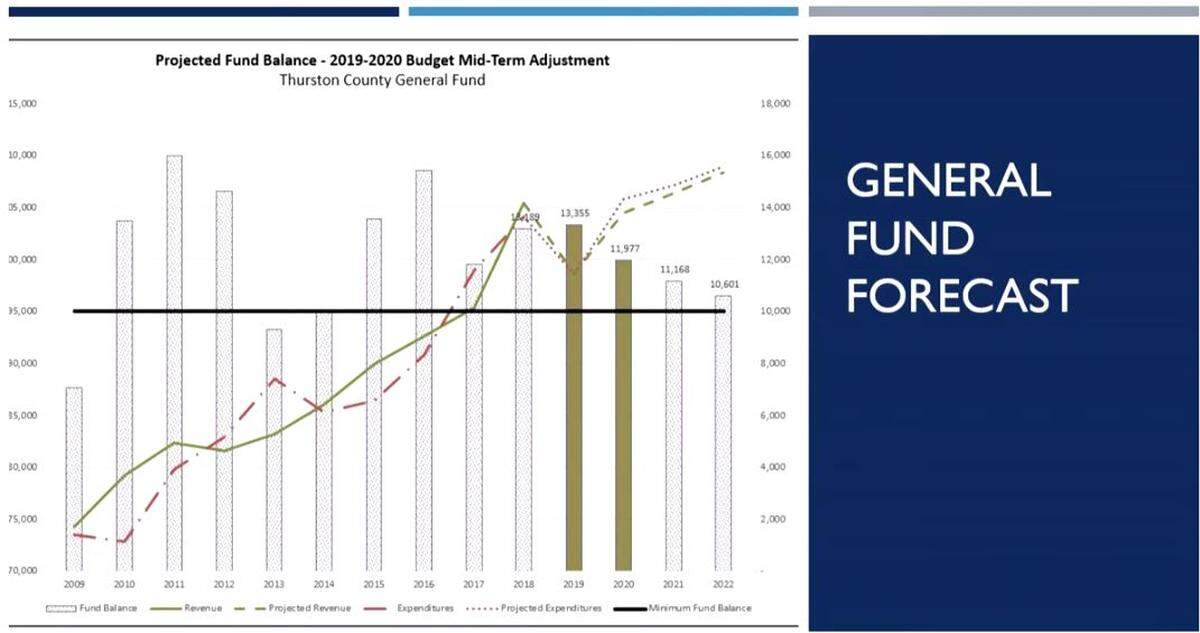
The less money the county is reimbursed, Campbell told The Olympian this week, the “less money the county has to pay for other services that we need, like the Sheriff’s Office.”
In the 2017-18 biennium, Auditor Hall says, total election costs in Thurston County were just over $1 million.
Out of that total, Hall says, the state reimbursed the county about $109,000 for referendums and advisory votes in 2017. The county picked up the state’s $580,000 bill for 2018.
Meanwhile, local jurisdictions reimbursed the county nearly $850,000 over that biennium, Hall said.
This year, the office’s estimates show that the General Election alone could cost the county about $664,500. That includes fixed costs that would be accruing anyway, such as salaries, Naputi-Pullar confirmed, and 15 percent overhead charged to each jurisdiction that goes into a fund the county uses to pay for elections equipment.
The state’s chunk of the estimate for that election adds up to about $358,000 and the federal piece adds up to about $109,400. Hall says she believes the federal and state costs should be lumped together because the federal government gives the state funding.
That’s most of the election’s cost, and the state won’t be required to reimburse the county for it. But Hall is spearheading the effort to change that.
What that change could look like
Hall said the state is now asking for more from counties when it comes to elections — same-day registration, for example — but it’s not giving counties more funding. And she pointed to cybersecurity as an annual cost now, rather than a one-time cost.
“We really do need a steady stream of funding,” Hall said. “And just this simple step of the state reimbursing us for their share of election costs would go a long way.”
State Sen. Sam Hunt, who represents the 22nd District that includes Olympia, Lacey, Tumwater and the northern reaches of Thurston County, pre-filed a bill to address the issue during the 2020 legislative session that begins Monday.
Hunt chairs the State Government, Tribal Relations & Elections committee and told The Olympian in an interview that he thinks the state’s “funding reimbursement formula for counties and elections is out of whack and has been for a number of years.”
“It’s an obvious unfunded mandate,” he said. “You have to have elections, and there should be a reasonable way to share the costs of those elections.”
He filed a bill with similar aims last year and said budget discussions involved whether the state could pay for return postage on ballots or for its share. It decided to start paying for return postage.
This year’s bill would require the state to pay its and the federal government’s prorated share of primary and general election costs in even-numbered years. Hunt said that if it were to go into effect, local jurisdictions and the county would start paying their portions of return postage, spreading out that burden.
Both Hall and Hunt expect the bill’s success will come down to the budget.
As it’s currently written, the law would go into effect in July 2021 if it were to pass.
This story was originally published January 12, 2020 at 6:00 AM.
.jpg)