
Second live Asian giant hornet caught in Whatcom. State races to narrow hunt for nest
A resident caught a second live Asian giant hornet southeast of Blaine, but efforts to track it back to its nest using a radio tag were unsuccessful, according to the Washington State Department of Agriculture.
Sven Spichiger, managing entomologist for the state agency, remained hopeful though.
“We’re starting to narrow down exactly where the nest is in the area,” he said in a media briefing on Monday, Oct. 12. “We’re pretty sure this is going to lead us to right where we need to go.”
There are at least two nests in Whatcom County, he said, with a possibility of a third.
Officials are racing to find the nests and destroy the Asian giant hornets in them so they don’t become established in Washington state. Popularly known as “murder hornets,” they are in their “slaughter phase” in which they target honeybee hives — although none have been attacked so far this year — and are approaching their breeding season.
“We’re hurrying as fast as we can, but there’s a lot of ground to cover,” Spichiger said.
The live capture combined with the trapping of two additional Asian giant hornets, which were found dead, earlier in October bumped to 18 the number of the invasive pests found in Whatcom County since winter 2019. They represent the first findings of the hornets in Washington state and the U.S.
The most recent captures were around Burk Road southeast of Blaine or elsewhere in the Blaine area, according to the Washington State Department of Agriculture.
Here are the details of the captures:
▪ Friday, Oct. 2: An Asian giant hornet was found dead in a trap placed by the state agency around Burk Road.
▪ Monday, Oct. 5: A resident captured a live Asian giant hornet flying on their property around Burk Road, the same location where the first live capture occurred near the end of September. They kept it alive and gave it to the state to use to track the hornet back to its nest. This was the second live capture and second tracking effort.
State officials said several neighbors near Burk Road also have reported seeing the hornets, adding that it is considering those probable sightings in its response plans.
▪ Friday, Oct. 9: An Asian giant hornet was found dead in a state trap. Different traps, which would capture a hornet without killing it, are being put up in the area. This was in the Blaine area, to the south.
Up to 2 inches long, the Asian giant hornet, or Vespa mandarinia, is the world’s largest hornet species. They are identifiable by their large yellow/orange heads.
The hornets are known for their painful stings. They will attack people and pets when threatened. People should be extremely cautious near them, agriculture officials said, and those who have allergic reactions to bee or wasp stings should never approach an Asian giant hornet.
Their native range is Asia. They also are known as the Japanese hornet, yak-killer hornet and the giant sparrow bee.
They are feared for the threat they pose to honeybees and, by extension, the valuable crops in Washington state that the bees pollinate.
They also are a threat to local pollinators such as wasps.
When Asian giant hornets are in their slaughter phase in the fall, they mark a honeybee hive, attack it, use their powerful jaws to decapitate the bees, and take the bees’ young to feed their own. They can destroy a hive within hours.
Hornet tracking, round two
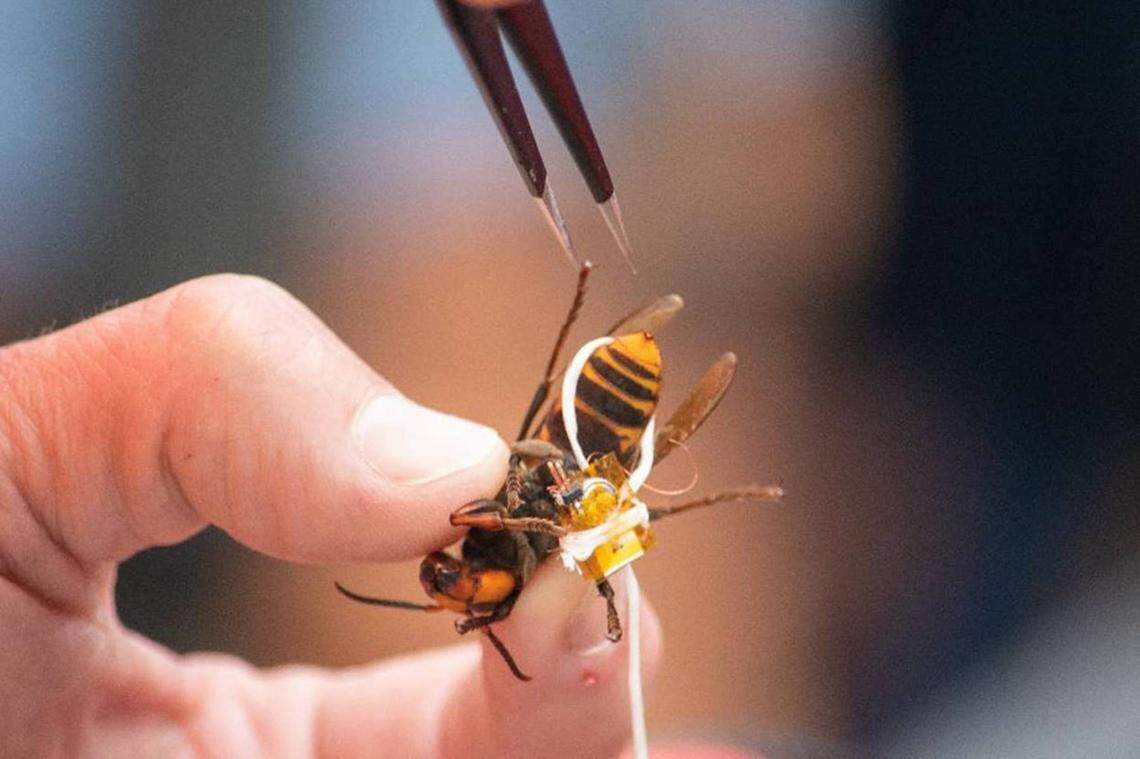
The first tracking effort at the end of September failed, in part, because the glue used to try to stick the radio tag on the hornet didn’t dry fast enough. The state found a solution for the second effort, which occurred on Wednesday, Oct. 7, using the hornet that a resident caught on Oct. 5.
That hornet was kept in a cooler to keep it calm and fed strawberry jelly to keep it alive after it was captured, officials said.
To get around the glue issue, officials tied the tag around the hornet, using dental floss and used different tracking equipment brought to the area by Vikram Iyer, a researcher from the University of Washington.
Iyer said the small radio tags use Bluetooth technology and were similar to what’s used to track larger wildlife.
The technology includes a phone app, which allowed some neighbors that had gathered to watch the tracking effort on Oct. 7 — after the fog cleared that day — to download it to try to help find the hornet using their phone’s Bluetooth.
“This is helpful especially for being able to search over a wide area,” Iyer said.
After the tag was tied on the feisty hornet, it was placed in a container to allow it to warm up before being put in an apple tree so it could take off from an elevated space. Spichiger said putting it up higher was based on suggestions from European counterparts who have experience with a similar species.
The hornet groomed itself, crawled around on the apple and then flew off, spiraling to orient itself before going from tree to tree. State agriculture workers, and the neighbors, followed the hornet from tree to tree for about an hour but lost her signal in the forest.
The heavily forested area presents a challenge to the tracking efforts, Spichiger said.
The tracking signal can transmit for 12 hours, but it couldn’t be picked up again though staff and several neighbors spent the afternoon searching the area for it, the agency said.
To help with the effort, the state has ordered radio transponders with a longer range and battery life, although those are expected to take three weeks to arrive.
Although a nest hasn’t been found, Spichiger said that current sighting information focuses the effort on Whatcom County, which is better than Western Washington as agriculture officials feared as they headed into their first ever trapping efforts for the hornets.
“It looks like we really are concentrated in one area, which gives us a fighting chance,” he said.
Report hornets
State agriculture officials continue to encourage the public to report sightings of Asian giant hornets, saying every report leads them closer to finding a nest.
Make reports at agr.wa.gov/hornets, which is preferred, and hornets@agr.wa.gov, or by calling 800-443-6684. Officials said it’s more important at this time of year to track the hornets or capture them while they’re alive instead of killing them.
When reporting, note the direction the hornet’s flying direction, which helps in tracking efforts.
An emergency line also has been set up for Washington state beekeepers to immediately call when they see their hives being attacked by Asian giant hornets. That phone number is 360-902-1880.
This story was originally published October 12, 2020 at 1:12 PM with the headline "Second live Asian giant hornet caught in Whatcom. State races to narrow hunt for nest."
