
Gov. Jay Inslee reflects on 12-year legacy. ‘Being governor is the greatest job’ in U.S.
Washington Gov. Jay Inslee is optimistic about the state’s future. The way the Democrat sees it, he’s had the “greatest job in the country” for the past 12 years.
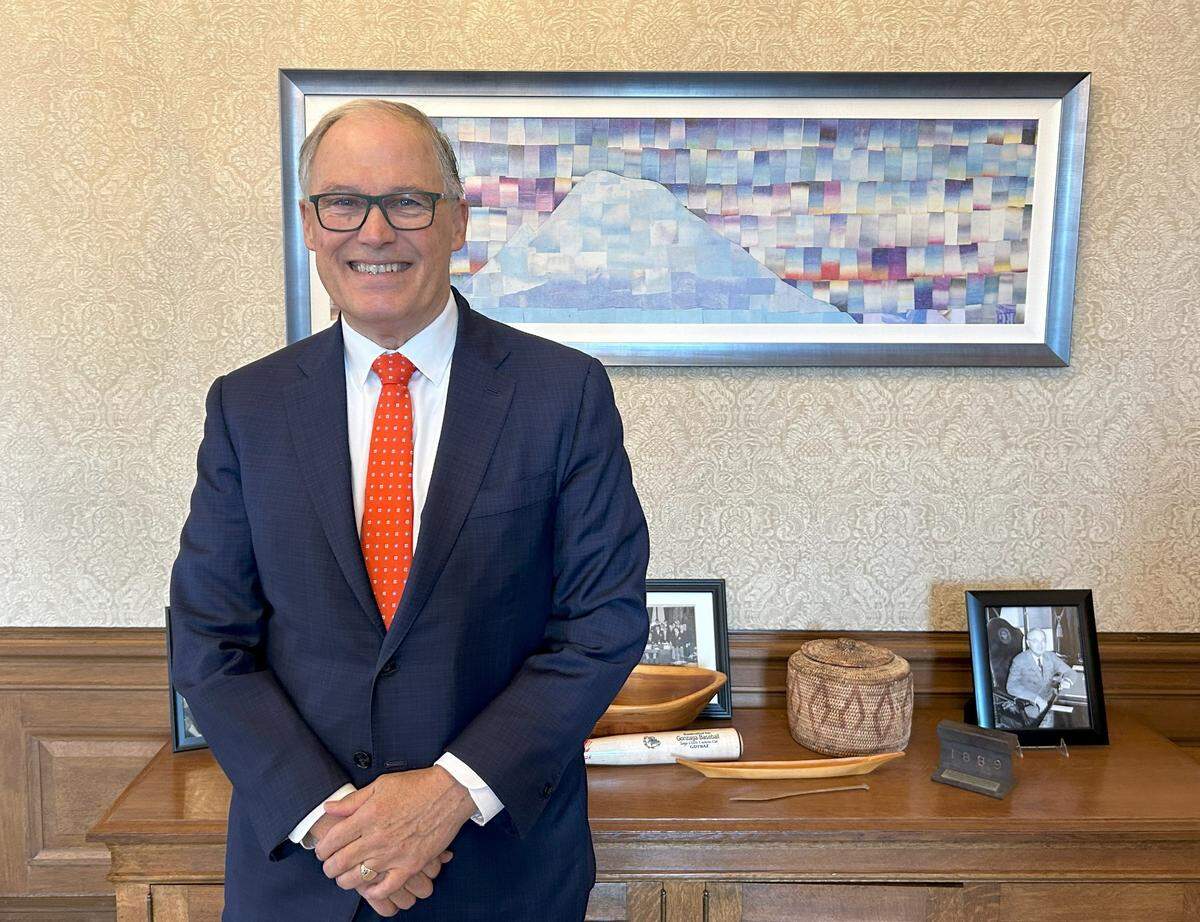
Inslee’s gubernatorial career is now coming to a close, and he met with a handful of state Capitol reporters on Dec. 19 to reflect on his legacy.
Topics ranged from his stance on gun safety — he highlighted efforts to fight the NRA — to the dangers of misinformation and algorithmic echo chambers.
He also formally debunked a nagging rumor that he’s moving to Idaho; he is not. Nor will he be running for president again.
Inslee told McClatchy that he did his best every day to help Washingtonians realize their dreams.
“I’m proud of that work,” Inslee said, citing the state’s responses to climate change and COVID-19. “I think we’ve had an astounding 12 years as Washington — and I credit Washington for that, not me.”
The ‘Idaho’ rumor
For months, Inslee’s team has denied a stubborn rumor that he plans to pack his bags for Idaho. He said on Dec. 19 that it’s the No. 1 question he gets asked while walking down the sidewalk.
“No, I am not moving to Idaho,” he told the Capitol press corps. “I do not have property in Idaho, and I never intend to have anything in Idaho — except to travel to Montana through that beautiful state. So it is objectively false.”
He added that he’s never even sent a postcard to the Gem State.
The best that Inslee can tell, the Idaho-rumor flame first sparked on right-wing radio. Soon it spread like wildfire.
“That started this rumor that just will not die,” Inslee said. “This is not going to change the course of human events, but it is an indication of how dangerous misinformation is right now.”
Legacy and regret
McClatchy asked Inslee about what he wants his legacy to be.
“I loved Washington state when I started; I love her more now,” he said. “But I hope people think, ‘He really understood the value system and the genius of the state of Washington, and was able to raise the ambitions of Washingtonians to do even more than we thought we could do.’”
Inslee linked his success as governor to his optimism, as well as his willingness to be bold. Case in point: He supported abolishing the death penalty even though it was controversial.
Inslee has long believed that people in this state are innovative and fair-minded. He said he was the first governor to push back against then-President Donald Trump’s Muslim travel ban: “It’s because I understood the heart of the state of Washington.”
As for whether he has any regrets?
Initially Inslee joked that he wishes he’d brought donuts more often to the communications team. He then acknowledged that during his time in office, some things did not work out as he’d hoped.
Once, Inslee invited an Illinois Republican who’d served in the U.S. Congress to meet with state GOP lawmakers who “refused to move a transportation package.” The idea was that the move might help to create a bipartisan consensus among the Washington lawmakers. To Inslee’s dismay, his guest was greeted by “the rudest behavior” he’d ever seen.
Inslee also brought up how, in 2016, he vetoed nearly 30 bills.
“I thought I could make a statement to try to break through a log jam. That didn’t work out,” Inslee said. “So there’s been tactical things that didn’t work out.”
Homelessness
Inslee acknowledged that Washingtonians are frustrated by homelessness, which has steadily risen in recent years.
“But I have been a champion to address this problem to the extent humanly possible,” the governor told reporters on Dec. 19. “I don’t think you can point to any other governor who has asked more and done more to address this problem.”
Inslee noted that Washington isn’t alone in grappling with homelessness.
A housing shortage persists nationwide, he said. Worker- and business-friendly Washington has drawn “a million people into our state, and states that have had ingress and have had hot economies have simultaneously had homelessness crises,” he added. The problem is present along the entire West Coast.
Inslee underscored efforts to build housing and prioritize addiction treatment programs and mental health services. During his time as governor, he said, the state has invested heavily in addressing the issue. At times he wanted to be more aggressive than the Legislature had an appetite for.
Inslee also pointed to the recent cleanup of 46 homeless encampments. Those who lived in the encampments were offered shelter, 70% of whom are still in housing today, he said.
The governor’s suggested 2025-27 budget, which he revealed on Dec. 17, would maintain the state’s housing programs, he said. Inslee’s ideas on revenue include a new wealth tax.
“Taxes are never happy events, but I’ve stood by my commitment to bring housing to Washingtonians,” he said.
Plans after leaving office
What does Inslee want to do after he moves out of the governor’s mansion?
“I don’t have any specific plans,” he told reporters, “except it does not include retirement.”
The state’s soon-to-be-ex governor will search for ways to continue combating climate change. He said he’s proud of the progress made in building a clean-energy economy.
Washington residents understand how special the state is, he said. In his view, no other place in the country enjoys the beauty that it has to offer — from glaciers to beaches, wheat fields to high plains.
“We got everything, and it’s right here,” Inslee said. “Washingtonians understand that — that’s one of the reasons they live here — and they want to protect it.”
Crime and police
Washington is facing a police-staffing shortage. The state recently ranked as one of the nation’s most dangerous, too. Asked what might account for these trends — and whether he’s leaving the state safer than when he started — Inslee told McClatchy about his previous efforts to improve both areas.
Under Inslee’s watch, the state has opened new satellite training facilities to help with recruiting police, he said. He also has focused on advancing gun-safety laws.
Inslee said it’s important to keep firearms away from kids and others who shouldn’t have access to weapons. In 1994, while serving in the U.S. Congress, he voted to ban “assault weapons,” a move that resulted in him losing his seat.
“Here I am as governor, back getting that law in the state of Washington,” he said, referencing a recent state law prohibiting the sale of such weapons. “So I’m proud of the work I’ve done to fight the NRA, to have some reasonable gun-safety laws to help in this regard. But there’s more work to be done.”
Inslee also emphasized his efforts to prevent crime, including when it comes to reducing the number of re-offenders. The recidivism rate has dropped by 30% in the past five years, he said, translating to about 1,500 fewer crimes.
Youth homelessness also has fallen by 40% in recent years, Inslee said. He pointed to improvements in access to mental-health services, both within and outside of schools.
Still, he said, the crime problem persists, and there have been some troubling trends.
Social media contributes to feelings of loneliness and isolation among young people, Inslee said. And there’s the presence of firearms.
“Guns are in everybody’s pocket nowadays, all these 15-year-olds,” he said.
Advice for Ferguson
McClatchy asked Inslee what advice he has for his successor, Gov.-elect Bob Ferguson. The answer was simple: Enjoy every single day.
Being Washington’s governor is an honor and joy, Inslee said. There’s no other position quite like it. Where else can you do as much for so many people in such a short time span?
“Being governor is the greatest job in the country because you can set the hopes of your state higher than they might have it, and then you’ll see the state respond to it,” he said. “That’s the joy that I’ve had … and you can see your dreams be vindicated.”
Washington’s value system
The state’s governors, regardless of party, have long adhered to a set of similar values, Inslee said.
The late Gov. Dan Evans, a Republican who served from 1965 to 1977, is remembered as an education advocate who helped establish the state’s community college system. Washington continues to make large investments in education today, Inslee said.
Evans was compassionate toward Vietnamese refugees, Inslee said. He again referenced his own effort in fighting back against Trump’s Muslim travel ban.
“The point is, those value systems of the state have continued sort of unaltered for decades,” Inslee said. “So I’m very confident of our future, that that’s going to continue.”
This story was originally published December 20, 2024 at 5:00 AM.
.jpg)