Thurston officials warn of layoffs, backlogs and delays if budget cuts are required
READ MORE
Thurston County works to close 2026 budget deficit
Thurston County commissioners are deciding how to close an estimated $36 million budget gap in the general fund, the county’s primary operating fund, for 2026.
Expand All
Proposed spending cuts would significantly hinder public services provided by Thurston County, officials warned the Board of County Commissioners last week.
The board heard budget cut proposals Wednesday from elected officials and department heads during an all-day meeting at The Atrium, the county’s administrative headquarters in Olympia.
Each office and department was tasked with finding ways to cut about 26% of spending from their general fund allocations. If this cut was enacted across the board, department officials warned it would result in significant layoffs, work backlogs, service delays and potential legal liability.
County leadership directed the exercise in an effort to find cost-cutting solutions to address a deficit in the county’s general fund.
The deficit has grown to an estimated $23.8 million in 2025 and is expected to widen without cuts. As the county’s primary operating fund, the general fund is used to pay for a multitude of services related to public safety, public health, emergency response, permitting, property taxes, parks, roads and much more.
In a Wednesday news release, the county attributed the deficit to rising costs outpacing its revenue sources in recent years.
The county says it’s facing growing costs caused by a growing population, inflation and unfunded mandates from the state and federal governments.
Meanwhile, the county has limited options for increasing revenue. The county’s general fund only receives about 8% of incoming property taxes, and state law restricts counties from increasing their property tax rate beyond 1% annually without voter approval.
Given the current situation, the county is considering asking voters to approve a higher property tax rate and annual limit of up to 6%, The Olympian previously reported.
At this point, such a ballot measure cannot be prepared before the end of the year. So, the county must first reckon with budget cuts for the coming calendar year.
Working through the budget-cutting exercise
The cuts proposed on Wednesday were shared during an open public meeting, but the county opted to not record the meeting as it usually does.
Because it was an exercise, the board did not make any significant budget decisions on Wednesday.
The county’s budget office is in the process of reviewing the information that was presented and adjusting the budget outlook based on recent developments.
Towards the end of the meeting, Commissioner and Board Chair Tye Menser said he doesn’t expect offices and departments to see cuts worse than what they were asked to present.
“It’s not quite a zero sum at this point because we sort of looked at worst-case scenario, and now we’re moving backward, hopefully in a positive way,” Menser said.
The board has until the end of the year to adopt a new biennial budget.
How did the exercise shake out?
Department heads who fall under the direction of County Manager Leonard Hernandez faithfully followed through on the exercise — even if it painted a catastrophic result.
For example, Ben Miller-Todd, director of Thurston County Emergency Services, presented a scenario where his department would lose 87% of its staff to reach the reduction target of cutting $633,528.
“In our first scenario, I’m not being hyperbolic here, it effectively dismantles Emergency Management,” Miller-Todd said.
County documents state this would lead to about a 90% reduction in the level of service to preparedness, response coordination, recovery efforts and mitigation of future disasters.
Hernandez later told the board that this was “not a doable scenario” for Emergency Management, but as the county manager, he required Miller-Todd to present it.
Elected officials, who also head their own county departments, do not answer to the county manager, so they varied in the extent of their participation in the budget exercise. Many of them pushed back on the proposed cuts as unworkable.
For example, Assessor Steven Drew told the board that he would have to cut about 42% of his staff to meet the reduction target.
“That’s not even in the realm of functional, doable,” Drew said.
The Assessor’s Office values all real and personal property within the county. These values are then factored into property tax bills.
In a document Drew provided to the board, he said the proposed cut would cripple his office and force him to decide what legal duties to neglect.
“It would be impossible to meet all statutory obligations, leading to an inaccurate tax base, increased taxpayer appeals and a breakdown in essential services that are foundational to the county’s financial stability,” his document states.
Sheriff says cuts would undo recent progress
The reduction target given to the Sheriff’s Office equates to about $5.6 million. Sheriff Derek Sanders said he could only achieve that by slashing 38 deputy sheriff full-time-equivalent positions.
“Twenty-five deputies would be laid off, if we stopped hiring today, which would include every single experienced lateral that we’ve hired over the last few years,” Sanders said.
Sanders said his office would be the worst-staffed Sheriff’s Office in the state with just 0.53 deputies per 1,000 people. In this scenario, he said his office would have eight fewer deputies than it did before voters approved the Public Safety Sales Tax. If that were to occur, he said the county should consider repealing the tax.
“I think people are going to feel very slighted based on what we told them would occur with that tax money,” Sanders said. “Not one thing we told them would occur, would have occurred at this point in time.”
Menser questioned Sander’s logic for repealing the tax, noting that layoffs would be even more severe without revenue from the tax. Commissioner Wayne Fournier likened the idea to “throwing the baby out with the bath water.”
“My opinion is that after you add 27 deputies with the Public Safety Tax, and you make promises to the voters about reduced time to calls, expanded services, all these different things, then you cut 38, then that’s not true,” Sanders said. “And that’s something that all of us are accountable to here as elected officials.”
With fewer positions, Sanders said deputies would only respond to in-person calls about violent felonies, domestic violence and significant traffic issues. All other 911 calls would be referred online, including burglaries and thefts.
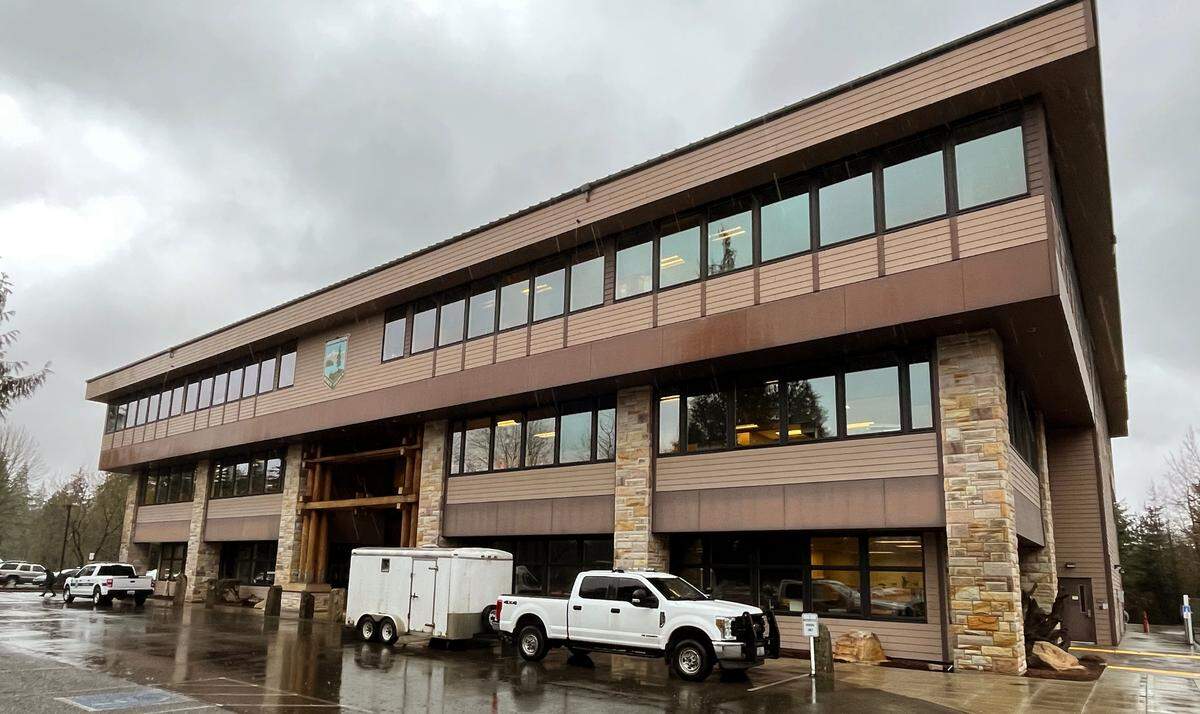
Additionally, Sanders said he would recommend the county sell the new Sheriff’s Office headquarters at 1111 Israel Road SW in Tumwater as it would no longer need the additional space with less staff.
The county finalized a $14.25 million real-estate deal to acquire the property earlier this year.
The reduction target would also require cutting $7.7 million from the corrections division, Sanders said. That would lead to the loss of 66 correction deputy positions out of a current total of 88 funded positions.
As a result, he said the jail would close down all dorms and only operate as a max unit, meaning its capacity would decrease from 390 people to 98.
To bring down the jail population, the Sheriff’s Office would only book people for crimes such as murder, manslaughter, rape, robbery, burglary, assault, arson and vehicular homicide.
Judges say courts cannot handle any cuts
John Skinder, the presiding judge for Thurston County Superior Court, said his court has been historically underfunded and there was “no way” for them to reach the reduction target.
“I think any cuts to the court system make it so there will be more costs that are caused by the ripple effect of when that happens,” Skinder said.
Superior Court is a state trial court that hears felony criminal cases, civil cases, juvenile and family law cases, appeals from lower courts and appeals from state administrative agencies.
The court does not decide its workload and it must meet its constitutional and statutory obligations. The proposed cuts would cause court case delays and leave victims at risk of further harm, opening the county to liability, a document prepared by the court states.
Brett Buckley, the presiding judge for Thurston County District Court, said his court could not provide funding reductions either.
“District Court is historically underfunded,” Buckley said. “If we look back, say, 17 years, we have among the lowest rate of budget increase in the county over that 17 years. It’s been a consistent trend.”
District Court hears misdemeanors, infractions, civil and small claims, protection orders and name changes for the county and local cities. It also operates mental health and veteran’s court and probation services.
Budget cuts would force the court to hear fewer cases even as case filings increase year over year, Buckley said.
“At the rate cases are being filed, we’re going to have to dismiss cases for speedy trial violations because we just can’t get them to court quick enough,” Buckley said.
Christy Peters, chief of staff for the Prosecuting Attorney’s Office, said meeting the reduction target would require laying off 43% of its criminal prosecution division, which equates to about 21 people.
“We would have approximately 2,500 cases that we would not be able to file, crimes that we would not be able to file, both in Superior Court and in District Court,” Peters said.
This could cause an increase in declined filings, backlogs, delayed cases and crime risks, Peters said.
“Based on our past experience on pandemic trends, crime likely rises if prosecution capacity is reduced,” Peters said. “Cases that go uncharged or are delayed prolong victims’ trauma and clearly this would be a decrease of community safety or quality of life here in Thurston County.”
The PAO also has a civil division that provides legal counsel to the county’s offices and departments. Peters said this division would see a 50% staffing reduction from 14 to 7 people under the proposed cuts.
Thurston County’s Public Defense Department did not present a budget cut proposal Wednesday.
The county is aiming to hire dozens more defense attorneys and support staff in the years ahead to meet new caseload standards set by the Washington state Supreme Court, The Olympian previously reported.
How to get involved
Thurston County has created a webpage for the public to learn more about the budget development process. The webpage can be found at www.thurstoncountywa.gov/balancing-budget.
The public may comment in-person or virtually during regular Board of County Commissioner meetings at The Atrium, located at 3000 Pacific Ave. SE, Room 110, in Olympia. Meeting dates and agendas are posted on the county’s website.
Written comments may be submitted to Clerk of the Board Amy Davis at amy.davis@co.thurston.wa.us up to two hours before a board meeting.
This story was originally published September 21, 2025 at 5:00 AM.