
First ‘murder hornet’ nest found in Washington. What will it take to get rid of them?
For the first time, an Asian giant hornet nest has been found in the United States — specifically southeast of Blaine, the Washington State Department of Agriculture announced on Friday, Oct. 23.
The state agency’s entomologists discovered the nest in the cavity of a tree, about 7 feet to 8 feet up, on private property on Thursday, Oct. 22, officials said. The nest was near an area cleared for a residence, on the edge of wooded land. It was in the Burk Road area, where there have been recent sightings of the unwanted hornets.
“While Asian giant hornets normally nest in the ground, they are occasionally found nesting in dead trees. Dozens of the hornets were seen entering and exiting the tree while the WSDA team was present,” the state agency said in a release.
State officials destroyed the nest early Saturday, Oct. 24. They couldn’t on Friday, Oct. 23, because of bad weather.
The state agency has been leading the effort to trap the hornets, find any nests and destroy them to prevent the invasive hornets from becoming established in Washington state and, by extension, the U.S.
They are popularly known as “murder hornets,” and all that have been found so far in the state and the U.S. have been in Whatcom County.
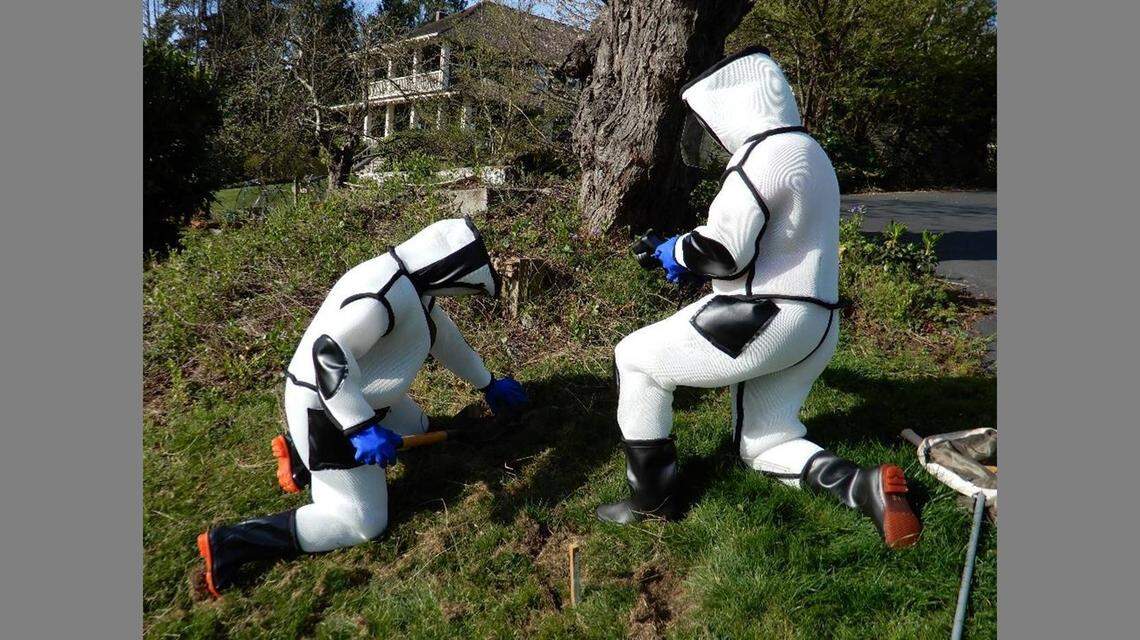
In order to destroy the nest, state officials had to order special suits because the ones used by beekeepers are too thin to protect against the hornets’ stings.
Asian giant hornets are bee killers
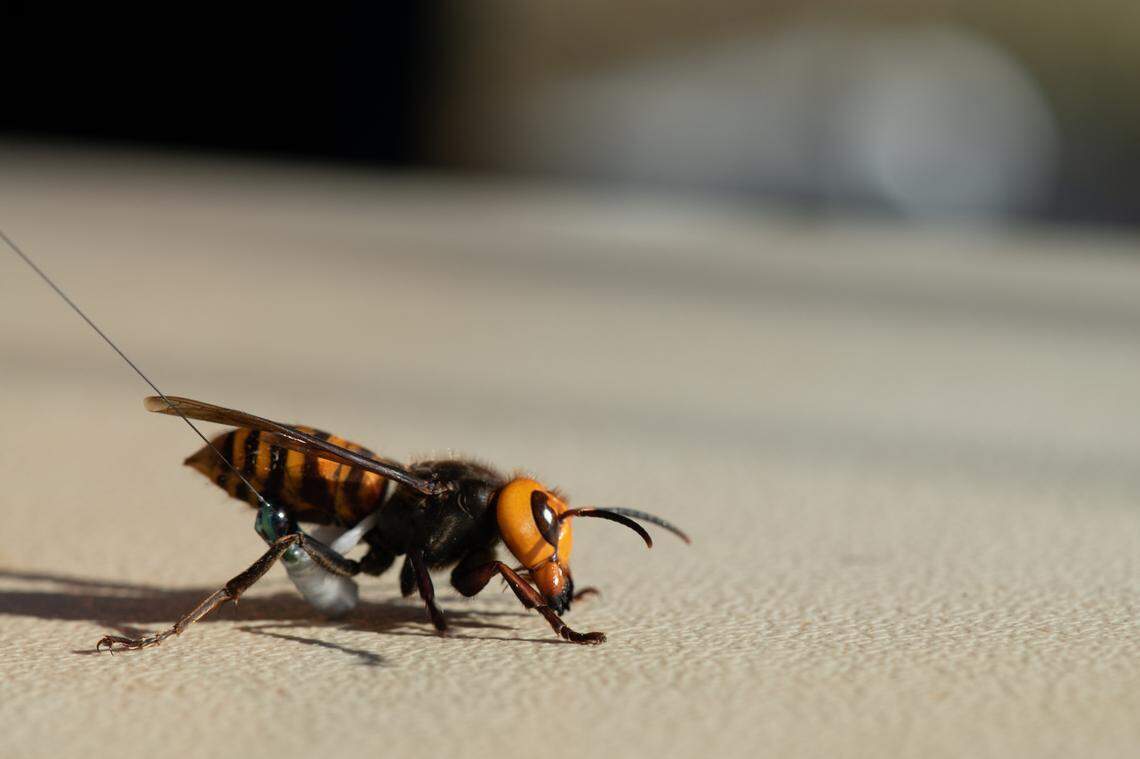
Up to 2 inches long, the Asian giant hornet, or Vespa mandarinia, is the world’s largest hornet species. They are identifiable by their large yellow/orange heads.
The hornets are known for their painful stings. They will attack people and pets when threatened. People should be extremely cautious near them, agriculture officials said, and those who have allergic reactions to bee or wasp stings should never approach an Asian giant hornet.
“Most people are going to experience severe pain if they’re stung by one of these,” said Sven Spichiger, managing entomologist for the Washington State Department of Agriculture, in a virtual media briefing on Friday.
Their native range is Asia. They also are known as the Japanese hornet, yak-killer hornet and the giant sparrow bee.
They are feared for the threat they pose to honeybees and, by extension, the valuable crops in Washington state that the bees pollinate.
They also are a threat to local pollinators such as wasps.
When Asian giant hornets are in their slaughter phase, which they’re entering now, they mark a honeybee hive, attack it, use their powerful jaws to decapitate the bees, and take the bees’ young to feed their own. A few hornets can kill 30,000 honeybees and take out a hive within hours, and managed honeybees here have no defense against them, according to Spichiger.
No hives have been attacked so far this year, he said, but the hornets that showed up in Whatcom County late in 2019 managed to destroy six or seven hives.
Finding the “murder hornet” nest
State agriculture officials said they were able to find this first nest after a total of four Asian giant hornets were found alive in their traps on Wednesday, Oct. 21, and Thursday morning in the area southeast of Blaine.
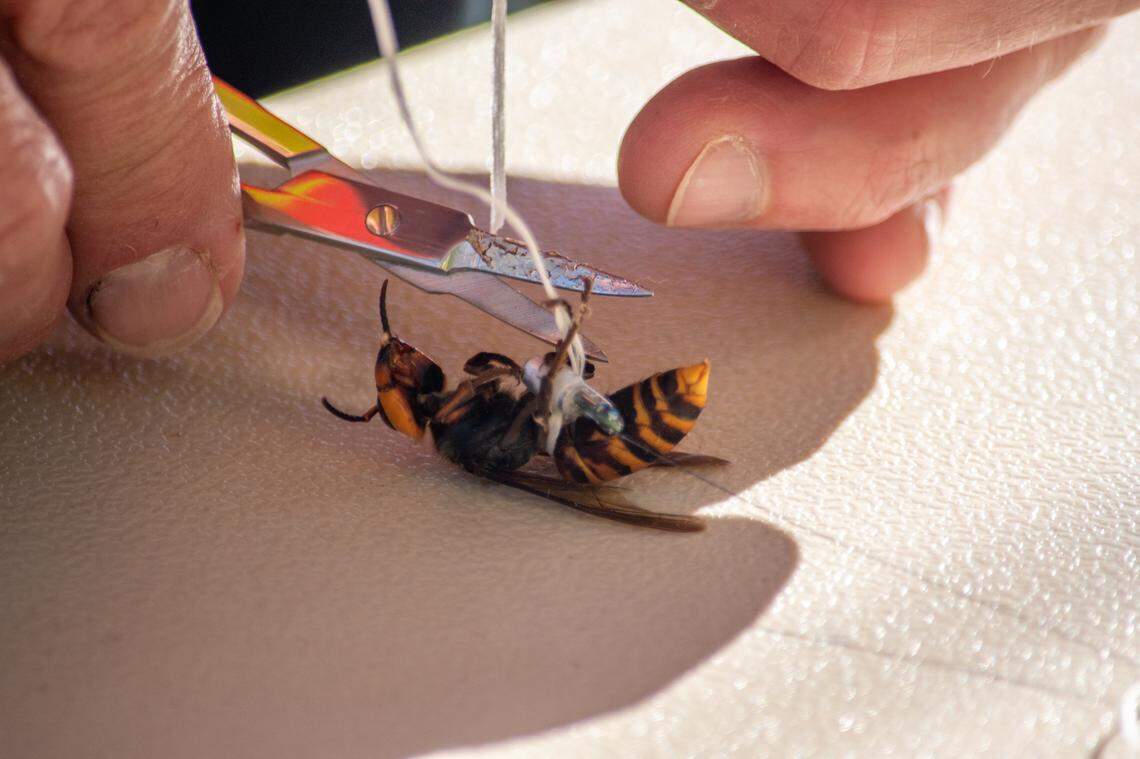
Entomologists used dental floss to tie radio trackers to three hornets, according to the release, and one led them to the nest, which they found about 4 p.m. on Thursday, Oct. 22.
The trackers were from the U.S. Department of Agriculture, which had been using them on the East Coast in an effort to eradicate the spotted lanternfly, an invasive species.
Looking at their heat signature, Spichiger said the nest in the tree is believed to be about the size of a basketball and contains up to 200 Asian giant hornets.
As many as 800 hornets could live in a nest, he said.
To get rid of the nest, the scientists planned to jam foam into the entrance, cover it with plastic wrap — Spichiger said they were trying to make sure on Friday that the hornets didn’t have another escape route — create a small opening in the wrap to put in a vacuum fixture and suck the hornets out alive into a chamber. From there, they were put into dry ice and kept for a number of research projects in the U.S. and other parts of the world.
The vacuum method has been used to extract yellow jackets, he explained.
In order to reach the hornets, they worked on scaffolding and wore what looks like white space suits, according to Spichiger. The suits are thick and made of foam to protect against Asian giant hornet stings. They have thick rubber boots and gloves.
“They will be stinging the suits,” he said Friday. “Hopefully they will not go all the way through. I guess we’ll find out tomorrow morning” whether they work.
The suits also have face shields because Asian giant hornets have been known to spray venom that can cause debilitating eye injury that’s permanent, Spichiger said.
For members of the public who fear being sprayed with hornet venom, Spichiger said people should worry only if they poke their head into a nest, handle the hornets, or try to remove their nest.
People don’t need to worry about hornets flying through the air and spraying them with venom, he said.
In addition to vacuuming out the hornets, officials were to check the nest to find out if there are breeding casts or if any of the breeding casts hatched and left the nest.
The property owner has given the state agency permission to destroy the nest and remove the tree, if necessary.
In all, 22 Asian giant hornets have been found in Whatcom County since winter 2019. They represent the first findings of the hornets in Washington state and the U.S.
Report hornets
State agriculture officials encourage the public to report sightings of Asian giant hornets, saying every report leads them closer to finding a nest.
Make reports at agr.wa.gov/hornets, which is preferred, and hornets@agr.wa.gov, or by calling 800-443-6684. Officials said it’s more important at this time of year to track the hornets or capture them while they’re alive instead of killing them.
When reporting, note the direction the hornet’s flying direction, which helps in tracking efforts.
An emergency line also has been set up for Washington state beekeepers to immediately call when they see their hives being attacked by Asian giant hornets. That phone number is 360-902-1880.
This story was originally published October 23, 2020 at 9:21 AM with the headline "First ‘murder hornet’ nest found in Washington. What will it take to get rid of them?."
